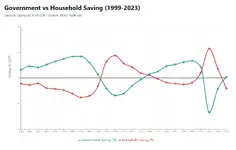
Isn’t the assumption that govt spending alone controls the economy? Isn’t govt spending about a third of GDP either more potential for gains in private?
If private spending and investment is booming or busting, shouldn’t the govt run counter to that?
And here’s the ideological side, shouldn’t the aim be to prioritise private growth, which expands capacity faster (higher efficiency and productivity gains) and then that allows more capacity for the govt to invest?
Eg grow the economy and use that increased capacity (more highly skilled workers, better equipment and technology, less people doing more) to leverage the public sector ( more worker capacity, skills, equipment, etc)?
I know the debts in your own currency but doesn’t mismanaging debt lead to loss of confidence from markets, worse exchange rates and causing real world issues?
It’s not a solvency issue but won’t the economic system punishing poor governance?
Just to clear up a common mixup first, because a lot of this debate ends up talking past itself. There are two different kinds of money in the system.
Base money (M1) is created by the Govt and central bank through spending and settlement.
Broad money (M2) is mostly created by private banks through lending.
Banks can create credit, but only the Govt can add net financial assets, via base money, to the system as a whole.
So it’s not that Govt spending “controls” the economy. It’s that Govt spending is what adds net financial assets to the private sector. Private credit expands activity by leveraging balance sheets. Public spending expands the base those balance sheets sit on.
That distinction matters for growth. Most major innovations start with public investment. The private sector is essential for turning those ideas into products and services at scale. Firms invest when they expect demand to hold up, labour to be available, infrastructure to function, and the rules to stay stable. Govt spending supports all of that by funding shared systems and by providing the income and savings that keep private balance sheets healthy as activity expands.
So yes, the Govt should run counter-cyclically. But that doesn’t mean shrinking. It means understanding what’s happening and shifting priorities. When private spending is booming, public policy should focus on easing real bottlenecks. When private spending contracts, public spending is what prevents a debt-driven downturn and a loss of capacity.
Construction is a good example. As private building slowed, Govt demand for construction was also pulled back, and the whole sector took a hit. Kainga Ora scaled back dozens of planned social housing developments and proposed cuts to hundreds of delivery roles, shrinking the public pipeline at exactly the wrong time. Construction activity fell to multi-year lows, employment dropped, and many tradies left NZ for Australia. That capacity loss weakens recovery and turns the next upswing inflationary.
The deeper issue is that NZ has underinvested in productive capacity for decades. Because of that, every recovery now runs into the same walls.
This is also why the “prioritise private growth first” idea fails. Private growth doesn’t reliably build the skills pipelines, transport networks, energy systems, health capacity, or planning institutions it depends on. Those are shared foundations. If the Govt waits for private expansion before investing, congestion, labour shortages, high costs, and inflation show up long before capacity actually expands.
On debt and confidence, markets aren’t staring at debt-to-GDP ratios in isolation. They care about economic resilience. Japan is the obvious case. It has a much higher debt ratio than the US or NZ, yet faces no solvency pressure because it issues debt in its own currency, has deep domestic ownership, and a real economy that can absorb shocks.
Credit rating agencies don’t assess governments the way households are assessed, despite the rhetoric. What they actually look at is growth capacity, institutional stability, and whether the system can cope when things go wrong. Confidence is rarely lost because a debt ratio crosses some magic line. It’s lost when institutions weaken, policy becomes erratic, capacity shrinks, or the economy can’t respond to shocks.
So the core issue isn’t “too much government” versus “too much private”. It’s whether public policy is building real capacity or quietly eroding it. When public investment is weak, private growth becomes debt-heavy and fragile. When the foundations are solid, private investment is cheaper, more productive, and more durable.