Politics πŸ€‘ Donald Trump

Agree with all of this and appears to be where NZ is stuck now. Stagnation and inflation.

Is it a chicken and egg situation though. Spending while at capacity cannot be actioned effectively as we’ve hit the limits to action it?

Aren’t low hanging fruit like getting more under employed into work, a focus on technology that can do more work with less, releasing land for housing, the RMA, open access to resource extraction, prioritise free trade deals, etc.
As I said earlier, a lot of what’s being described as β€œcapacity limits” aren’t natural ceilings. They’re the result of recent policy choices that cut public investment, cancelled projects, and weakened delivery institutions. That matters, because it changes how we should think about sequencing and what action is actually possible.
Spending blindly into constraints doesn’t work. But using constraints as a reason for inaction is backwards. Capacity isn’t fixed. It varies by sector and is shaped by past policy decisions.
When I say β€œexpand productive capacity”, I mean the practical things that let the economy produce more real goods and services without jamming up: workers, skills, energy, transport, housing, health services, and the institutions that make those systems function. Much of this is collective infrastructure. When it’s missing or underbuilt, costs lift everywhere. When it’s in good shape, businesses can operate with less friction and lower cost.

So if we’re looking for genuine low-hanging fruit in NZ, it isn’t abstract. It’s clear where capacity is binding and where immediate Govt action would expand it.

Health workforce and training capacity.
Make primary healthcare properly free at the point of use. Expand training places, stabilise hiring, and reduce burnout. Close the pay and conditions gap with Australia so staff stop leaving. Health capacity affects labour supply, productivity, and costs across the economy over time. A weak health system is a cost of living pressure in its own right.

Housing, local Govt funding for consenting and infrastructure.
Councils are financially penalised for growth. They carry the cost of consenting teams, compliance, and major infrastructure, and mostly fund it through rates. That pushes up housing costs and fees without expanding capacity. Direct central Govt funding for planning capacity and associated infrastructure would unblock housing delivery far more reliably than RMA reform alone. A dedicated infrastructure fund for local Govt would lower the rates burden and remove a major choke point to development.

Energy generation and grid capacity.
Cheap, reliable power lowers costs everywhere. When upgrades are delayed or supply is tight, it shows up in power bills first, then across the wider economy. If you want high leverage, this is it.

Transport and logistics, especially rail and ferries.
NZ’s freight system is fragile. Rail is constrained, ports are under pressure, and the Cook Strait is a single point of failure. When freight is inefficient, households pay for it through food and consumer prices.
The cancelled rail-enabled ferry programme is a clear example of capacity being cut, not expanded. Sunk costs were written off and reliance on ageing vessels was extended well past their use by date. Rail-enabled ferries and port upgrades aren’t optional.
Mode-shift infrastructure belongs in the same bucket. Safe cycle networks and reliable public transport are cheap compared to the cost of congestion. Every person who can walk, bike, or use public transport is one less car on the road. That frees road space for freight, trades, and people who genuinely need to drive. This isn’t about forcing behaviour. It’s basic efficiency. Congestion is a productivity tax.

Food supply, pricing, and resilience.
Food is expensive here for structural reasons. Supermarket concentration is extreme, logistics costs are baked in, and domestic pricing often gets dragged toward export linked pricing even when local supply is fine. There are policy tools available to ease this without undermining exports. Breaking supermarket market power, improving logistics, and supporting domestic supply for domestic consumption would move the needle on food prices quickly.

Skills, apprenticeships, and R&D.
Make training and education free. Build skills pipelines that line up with long term projects, not stop-start cycles. Increase R&D funding and stop treating universities as an afterthought. Skills and innovation aren’t optional. They’re part of the productive base. When they’re thin, growth doesn’t get far before it stalls.

Primary education, school participation and support.
Expanding school lunches improves attendance, learning outcomes, and long-term workforce quality. It also helps families right now with cost of living pressures. Properly funding primary education, backing teachers, and meaningfully funding ECE strengthens capacity across the entire economy. The cost of raising a family in NZ is extreme, and policy choices are a big part of that.

None of this is exotic. It’s the unglamorous foundation the private sector builds on.
So when people say β€œfocus on productivity before spending”, this is what that looks like in practice. Productivity doesn’t appear by magic. It comes from infrastructure, skills, energy, health, food systems, and institutions that lower real costs and reduce bottlenecks.
Freezing or cutting public investment because we think we’re β€œat capacity” doesn’t fix the constraint. It hardens it. Then every attempt at growth runs back into the same inflation and bottleneck story.
That’s how NZ stays stuck between stagnation and inflation β€” not because the Govt can’t act, but because it keeps stepping back from the parts of the economy everything else depends on.

 

NZWarriors.com

Without doing any research cos I'm lazy, do you know which parties currently meet most of your points above, in terms of their messaging of what they intend to do in future if they were to get in power?

Regardless of whether they'd actually do any of their promises, of course, cos politics gonna politic. πŸ˜…
 
With 68-75% of debt held domestically and 25-32% foreign owned, is there a chance that the risk gets to high at some point for all involved? And also your post about creating money, with debts at those levels of America currently with money creation as a contributing factor, is it being used wisely in your view or wasted?
I haven’t had time to read the Forbes article, but I can probably guess the framing, who holds the debt, how big the number is, and whether that creates risk.

On who holds US debt:
Domestic versus foreign ownership doesn’t create a solvency risk. The US issues debt in its own currency. US Treasuries are bought in USD and interest is paid in USD. The same applies to NZ Govt bonds. That’s the crucial feature of sovereign bonds issued in a country’s own currency.
Foreign holders own Treasuries because they want a safe USD asset, not because the US needs their money to spend. If foreign demand fell, the adjustment would show up through prices, yields, or the exchange rate, not through an inability to pay. The real risk here isn’t β€œtoo much debt”, it’s political dysfunction and rule instability.

On money creation and whether it’s being used well:
Money creation itself isn’t the problem. It’s how the system works. The issue is what the money is used for.
Too much spending has flowed into asset prices, rents, and financial markets instead of expanding real productive capacity. Healthcare is a good example. The US already spends more per capita than any other country, but without a universal public system those dollars don’t deliver better outcomes. They translate into higher costs, weaker access, and a less resilient workforce.

So the risk isn’t debt levels or money creation per se. It’s misallocation and weak institutions, which create instability. Treating this like a household debt problem leads to austerity, which makes those risks worse, not better.
 

NZWarriors.com

I haven’t had time to read the Forbes article, but I can probably guess the framing, who holds the debt, how big the number is, and whether that creates risk.

On who holds US debt:
Domestic versus foreign ownership doesn’t create a solvency risk. The US issues debt in its own currency. US Treasuries are bought in USD and interest is paid in USD. The same applies to NZ Govt bonds. That’s the crucial feature of sovereign bonds issued in a country’s own currency.
Foreign holders own Treasuries because they want a safe USD asset, not because the US needs their money to spend. If foreign demand fell, the adjustment would show up through prices, yields, or the exchange rate, not through an inability to pay. The real risk here isn’t β€œtoo much debt”, it’s political dysfunction and rule instability.

On money creation and whether it’s being used well:
Money creation itself isn’t the problem. It’s how the system works. The issue is what the money is used for.
Too much spending has flowed into asset prices, rents, and financial markets instead of expanding real productive capacity. Healthcare is a good example. The US already spends more per capita than any other country, but without a universal public system those dollars don’t deliver better outcomes. They translate into higher costs, weaker access, and a less resilient workforce.

So the risk isn’t debt levels or money creation per se. It’s misallocation and weak institutions, which create instability. Treating this like a household debt problem leads to austerity, which makes those risks worse, not better.
I know the debts in your own currency but doesn’t mismanaging debt lead to loss of confidence from markets, worse exchange rates and causing real world issues?

It’s not a solvency issue but won’t the economic system punishing poor governance?
 
Without doing any research cos I'm lazy, do you know which parties currently meet most of your points above, in terms of their messaging of what they intend to do in future if they were to get in power?

Regardless of whether they'd actually do any of their promises, of course, cos politics gonna politic. πŸ˜…
I had a self-imposed exile from these political subforums last year. I promised myself that if I came back, I’d approach these discussions in a less confrontational and more constructive way. So this question is naturally a bit loaded – people are pretty wedded to their political team(s). This is probably where the thread turns on me. Lol.

Short answer: the Greens are the closest to articulating this framework, even if they don’t always use the same language.
Their fiscal strategy explicitly shifts the focus away from arbitrary debt targets and toward real economic capacity, underinvestment risk, and productive public investment. They treat infrastructure, health, education, climate resilience, and skills not as β€œcosts” to be minimised, but as foundations that determine productivity, resilience, and long-term fiscal sustainability. Where they come unstuck is that they still largely operate within a tax-then-spend mindset, which keeps part of the orthodox frame intact. I’ve linked their Fiscal Strategy document below – it’s genuinely worth a read if you have the time.

Labour, in practice, still operates largely inside orthodox fiscal constraints. While it supports public investment rhetorically, policy is framed through debt ceilings, surplus targets, and β€œaffordability” in a household sense. Like the Greens, they follow a tax-then-spend framing, which ultimately limits how far they can push policy, even when the diagnosis is partly right.
National, ACT, and to a lesser extent NZ First appear firmly orthodox. We can see this in the current term: debt and spending are treated as primary risks, fiscal tightening is prioritised, and delivery is pushed onto the market despite clear capacity constraints. That worldview is internally consistent, but only if you accept household-style debt assumptions and debunked ideas like crowding out, which don’t reflect how the economy actually functions. From there, it assumes the state should step back from building capacity, even though that withdrawal is what creates the bottlenecks in the first place.

Whether any party would fully deliver on this in government is a separate question. But analytically, the Greens are the only ones clearly challenging the underlying fiscal frame, rather than just rearranging priorities within it.

 
Last edited:

NZWarriors.com

Isn’t the assumption that govt spending alone controls the economy? Isn’t govt spending about a third of GDP either more potential for gains in private?

If private spending and investment is booming or busting, shouldn’t the govt run counter to that?

And here’s the ideological side, shouldn’t the aim be to prioritise private growth, which expands capacity faster (higher efficiency and productivity gains) and then that allows more capacity for the govt to invest?

Eg grow the economy and use that increased capacity (more highly skilled workers, better equipment and technology, less people doing more) to leverage the public sector ( more worker capacity, skills, equipment, etc)?

I know the debts in your own currency but doesn’t mismanaging debt lead to loss of confidence from markets, worse exchange rates and causing real world issues?

It’s not a solvency issue but won’t the economic system punishing poor governance?

Just to clear up a common mixup first, because a lot of this debate ends up talking past itself. There are two different kinds of money in the system.
Base money (M1) is created by the Govt and central bank through spending and settlement.
Broad money (M2) is mostly created by private banks through lending.
Banks can create credit, but only the Govt can add net financial assets, via base money, to the system as a whole.

So it’s not that Govt spending β€œcontrols” the economy. It’s that Govt spending is what adds net financial assets to the private sector. Private credit expands activity by leveraging balance sheets. Public spending expands the base those balance sheets sit on.
That distinction matters for growth. Most major innovations start with public investment. The private sector is essential for turning those ideas into products and services at scale. Firms invest when they expect demand to hold up, labour to be available, infrastructure to function, and the rules to stay stable. Govt spending supports all of that by funding shared systems and by providing the income and savings that keep private balance sheets healthy as activity expands.

So yes, the Govt should run counter-cyclically. But that doesn’t mean shrinking. It means understanding what’s happening and shifting priorities. When private spending is booming, public policy should focus on easing real bottlenecks. When private spending contracts, public spending is what prevents a debt-driven downturn and a loss of capacity.
Construction is a good example. As private building slowed, Govt demand for construction was also pulled back, and the whole sector took a hit. Kainga Ora scaled back dozens of planned social housing developments and proposed cuts to hundreds of delivery roles, shrinking the public pipeline at exactly the wrong time. Construction activity fell to multi-year lows, employment dropped, and many tradies left NZ for Australia. That capacity loss weakens recovery and turns the next upswing inflationary.
The deeper issue is that NZ has underinvested in productive capacity for decades. Because of that, every recovery now runs into the same walls.

This is also why the β€œprioritise private growth first” idea fails. Private growth doesn’t reliably build the skills pipelines, transport networks, energy systems, health capacity, or planning institutions it depends on. Those are shared foundations. If the Govt waits for private expansion before investing, congestion, labour shortages, high costs, and inflation show up long before capacity actually expands.

On debt and confidence, markets aren’t staring at debt-to-GDP ratios in isolation. They care about economic resilience. Japan is the obvious case. It has a much higher debt ratio than the US or NZ, yet faces no solvency pressure because it issues debt in its own currency, has deep domestic ownership, and a real economy that can absorb shocks.
Credit rating agencies don’t assess governments the way households are assessed, despite the rhetoric. What they actually look at is growth capacity, institutional stability, and whether the system can cope when things go wrong. Confidence is rarely lost because a debt ratio crosses some magic line. It’s lost when institutions weaken, policy becomes erratic, capacity shrinks, or the economy can’t respond to shocks.

So the core issue isn’t β€œtoo much government” versus β€œtoo much private”. It’s whether public policy is building real capacity or quietly eroding it. When public investment is weak, private growth becomes debt-heavy and fragile. When the foundations are solid, private investment is cheaper, more productive, and more durable.
 

NZWarriors.com

Just to clear up a common mixup first, because a lot of this debate ends up talking past itself. There are two different kinds of money in the system.
Base money (M1) is created by the Govt and central bank through spending and settlement.
Broad money (M2) is mostly created by private banks through lending.
Banks can create credit, but only the Govt can add net financial assets, via base money, to the system as a whole.

So it’s not that Govt spending β€œcontrols” the economy. It’s that Govt spending is what adds net financial assets to the private sector. Private credit expands activity by leveraging balance sheets. Public spending expands the base those balance sheets sit on.
That distinction matters for growth. Most major innovations start with public investment. The private sector is essential for turning those ideas into products and services at scale. Firms invest when they expect demand to hold up, labour to be available, infrastructure to function, and the rules to stay stable. Govt spending supports all of that by funding shared systems and by providing the income and savings that keep private balance sheets healthy as activity expands.

So yes, the Govt should run counter-cyclically. But that doesn’t mean shrinking. It means understanding what’s happening and shifting priorities. When private spending is booming, public policy should focus on easing real bottlenecks. When private spending contracts, public spending is what prevents a debt-driven downturn and a loss of capacity.
Construction is a good example. As private building slowed, Govt demand for construction was also pulled back, and the whole sector took a hit. Kainga Ora scaled back dozens of planned social housing developments and proposed cuts to hundreds of delivery roles, shrinking the public pipeline at exactly the wrong time. Construction activity fell to multi-year lows, employment dropped, and many tradies left NZ for Australia. That capacity loss weakens recovery and turns the next upswing inflationary.
The deeper issue is that NZ has underinvested in productive capacity for decades. Because of that, every recovery now runs into the same walls.

This is also why the β€œprioritise private growth first” idea fails. Private growth doesn’t reliably build the skills pipelines, transport networks, energy systems, health capacity, or planning institutions it depends on. Those are shared foundations. If the Govt waits for private expansion before investing, congestion, labour shortages, high costs, and inflation show up long before capacity actually expands.

On debt and confidence, markets aren’t staring at debt-to-GDP ratios in isolation. They care about economic resilience. Japan is the obvious case. It has a much higher debt ratio than the US or NZ, yet faces no solvency pressure because it issues debt in its own currency, has deep domestic ownership, and a real economy that can absorb shocks.
Credit rating agencies don’t assess governments the way households are assessed, despite the rhetoric. What they actually look at is growth capacity, institutional stability, and whether the system can cope when things go wrong. Confidence is rarely lost because a debt ratio crosses some magic line. It’s lost when institutions weaken, policy becomes erratic, capacity shrinks, or the economy can’t respond to shocks.

So the core issue isn’t β€œtoo much government” versus β€œtoo much private”. It’s whether public policy is building real capacity or quietly eroding it. When public investment is weak, private growth becomes debt-heavy and fragile. When the foundations are solid, private investment is cheaper, more productive, and more durable.
In your view where does the current Government sit Rizzah? Feels to me like it's not so quietly eroding it.

And thanks heaps for all this, haven't had time to digest or educate meself yet!
 
In your view where does the current Government sit Rizzah? Feels to me like it's not so quietly eroding it.

And thanks heaps for all this, haven't had time to digest or educate meself yet!
I covered that a bit in my reply to @Evil_Mush. Yes, I think the current Government is eroding capacity rather than strengthening it, especially by pulling back public pipelines and relying on markets where capacity is already stretched.
 

NZWarriors.com

Just to clear up a common mixup first, because a lot of this debate ends up talking past itself. There are two different kinds of money in the system.
Base money (M1) is created by the Govt and central bank through spending and settlement.
Broad money (M2) is mostly created by private banks through lending.
Banks can create credit, but only the Govt can add net financial assets, via base money, to the system as a whole.

So it’s not that Govt spending β€œcontrols” the economy. It’s that Govt spending is what adds net financial assets to the private sector. Private credit expands activity by leveraging balance sheets. Public spending expands the base those balance sheets sit on.
That distinction matters for growth. Most major innovations start with public investment. The private sector is essential for turning those ideas into products and services at scale. Firms invest when they expect demand to hold up, labour to be available, infrastructure to function, and the rules to stay stable. Govt spending supports all of that by funding shared systems and by providing the income and savings that keep private balance sheets healthy as activity expands.

So yes, the Govt should run counter-cyclically. But that doesn’t mean shrinking. It means understanding what’s happening and shifting priorities. When private spending is booming, public policy should focus on easing real bottlenecks. When private spending contracts, public spending is what prevents a debt-driven downturn and a loss of capacity.
Construction is a good example. As private building slowed, Govt demand for construction was also pulled back, and the whole sector took a hit. Kainga Ora scaled back dozens of planned social housing developments and proposed cuts to hundreds of delivery roles, shrinking the public pipeline at exactly the wrong time. Construction activity fell to multi-year lows, employment dropped, and many tradies left NZ for Australia. That capacity loss weakens recovery and turns the next upswing inflationary.
The deeper issue is that NZ has underinvested in productive capacity for decades. Because of that, every recovery now runs into the same walls.

This is also why the β€œprioritise private growth first” idea fails. Private growth doesn’t reliably build the skills pipelines, transport networks, energy systems, health capacity, or planning institutions it depends on. Those are shared foundations. If the Govt waits for private expansion before investing, congestion, labour shortages, high costs, and inflation show up long before capacity actually expands.

On debt and confidence, markets aren’t staring at debt-to-GDP ratios in isolation. They care about economic resilience. Japan is the obvious case. It has a much higher debt ratio than the US or NZ, yet faces no solvency pressure because it issues debt in its own currency, has deep domestic ownership, and a real economy that can absorb shocks.
Credit rating agencies don’t assess governments the way households are assessed, despite the rhetoric. What they actually look at is growth capacity, institutional stability, and whether the system can cope when things go wrong. Confidence is rarely lost because a debt ratio crosses some magic line. It’s lost when institutions weaken, policy becomes erratic, capacity shrinks, or the economy can’t respond to shocks.

So the core issue isn’t β€œtoo much government” versus β€œtoo much private”. It’s whether public policy is building real capacity or quietly eroding it. When public investment is weak, private growth becomes debt-heavy and fragile. When the foundations are solid, private investment is cheaper, more productive, and more durable.
This is quality stuff!

Taking it a step back. Money is a placeholder. It’s just a value we place on all the labour and resources in the economy. An accounting and coordination tool to organise labour and resources.

Wages are how we differentiate value for each role and dividend up the collective pie. How we push labour to where it’s most useful (why I’m anti huge minimum wages). If labour is constrained, adding more money just makes the same stuff at higher prices.

Therefore budget limits are real world limits. We are limited by labour and resources. We can’t just invest more because the economy can’t physically do it. We can prioritise somethings and disincentive others but the potential for increasing capacity and investing is limited by the real world restraints.

Eg the Greens budget to massively borrow, tax and spend - surely it’s impossible due to the physical constraints, even if they can β€˜make the money’ to pay for it?

What’s your view on this? Enjoying the quality discussions.
 
This is quality stuff!

Taking it a step back. Money is a placeholder. It’s just a value we place on all the labour and resources in the economy. An accounting and coordination tool to organise labour and resources.

Wages are how we differentiate value for each role and dividend up the collective pie. How we push labour to where it’s most useful (why I’m anti huge minimum wages). If labour is constrained, adding more money just makes the same stuff at higher prices.

Therefore budget limits are real world limits. We are limited by labour and resources. We can’t just invest more because the economy can’t physically do it. We can prioritise somethings and disincentive others but the potential for increasing capacity and investing is limited by the real world restraints.

Eg the Greens budget to massively borrow, tax and spend - surely it’s impossible due to the physical constraints, even if they can β€˜make the money’ to pay for it?

What’s your view on this? Enjoying the quality discussions.

Money is a coordination tool, and real limits are labour, materials, energy, and productive capacity. If you push demand into an economy that can’t respond, you get inflation, not more output. On that, we agree.
Where I’d push back is the leap from β€œreal limits exist” to β€œwe therefore can’t invest more”.
Those limits aren’t fixed. They’re shaped by past policy choices.

In NZ, a lot of what’s being described as β€œthe economy can’t physically do it” is the result of capacity being run down over years. Training places were cut. Ministries were shrunk. Project pipelines were stopped and started. Health workers, young professionals, and construction workers were lost to Australia. Planning and delivery institutions were hollowed out. When you do that, any renewed spending will likely run into inflation. That’s not proof the state has no room to act. It’s proof capacity was allowed to shrink.
And crucially, that capacity isn’t fixed. It can be rebuilt. Through stable project pipelines, expanded training, retention of skilled workers, investment in health and infrastructure, and properly funding the institutions that deliver. Those are policy choices, not physical impossibilities.
This is where budget limits get misread. Yes, there are real world limits. But treating today’s limits as fixed turns underinvestment into justification for inaction. That’s how you lock the economy into stagnation.

On wages, I’d frame it similarly. If labour is scarce because we haven’t trained, retained, or supported enough workers, suppressing wages doesn’t solve the constraint. It just reallocates pain. Expanding capacity through training, health, housing, transport, and stable demand does.

On the Greens point, no serious proposal is about spending everything at once. The question is sequencing. Investment that expands capacity, skills, energy, housing, logistics, health, changes the inflation picture over time. Investment that doesn’t will show up as price pressure. That’s a design problem, not a reason to default to austerity.
So yes, the economy has real limits. But the current Govt hasn’t been bumping into hard physical ceilings. It’s been actively shrinking capacity, then pointing to the resulting constraints as proof that nothing more is possible.
That’s the logic I’m pushing back on.
 
Money is a coordination tool, and real limits are labour, materials, energy, and productive capacity. If you push demand into an economy that can’t respond, you get inflation, not more output. On that, we agree.
Where I’d push back is the leap from β€œreal limits exist” to β€œwe therefore can’t invest more”.
Those limits aren’t fixed. They’re shaped by past policy choices.

In NZ, a lot of what’s being described as β€œthe economy can’t physically do it” is the result of capacity being run down over years. Training places were cut. Ministries were shrunk. Project pipelines were stopped and started. Health workers, young professionals, and construction workers were lost to Australia. Planning and delivery institutions were hollowed out. When you do that, any renewed spending will likely run into inflation. That’s not proof the state has no room to act. It’s proof capacity was allowed to shrink.
And crucially, that capacity isn’t fixed. It can be rebuilt. Through stable project pipelines, expanded training, retention of skilled workers, investment in health and infrastructure, and properly funding the institutions that deliver. Those are policy choices, not physical impossibilities.
This is where budget limits get misread. Yes, there are real world limits. But treating today’s limits as fixed turns underinvestment into justification for inaction. That’s how you lock the economy into stagnation.

On wages, I’d frame it similarly. If labour is scarce because we haven’t trained, retained, or supported enough workers, suppressing wages doesn’t solve the constraint. It just reallocates pain. Expanding capacity through training, health, housing, transport, and stable demand does.

On the Greens point, no serious proposal is about spending everything at once. The question is sequencing. Investment that expands capacity, skills, energy, housing, logistics, health, changes the inflation picture over time. Investment that doesn’t will show up as price pressure. That’s a design problem, not a reason to default to austerity.
So yes, the economy has real limits. But the current Govt hasn’t been bumping into hard physical ceilings. It’s been actively shrinking capacity, then pointing to the resulting constraints as proof that nothing more is possible.
That’s the logic I’m pushing back on.
I wholeheartedly agree on most of this.

Differ on what’s possible and the best way forward but the underlying concepts are solid.

It’s around this why I believe Clarke and Cullen were so powerful. They understood this. Ardern and Luxon don’t.

Do they teach this in political science/ studies?
 

NZWarriors.com

Money is a coordination tool, and real limits are labour, materials, energy, and productive capacity. If you push demand into an economy that can’t respond, you get inflation, not more output. On that, we agree.
Where I’d push back is the leap from β€œreal limits exist” to β€œwe therefore can’t invest more”.
Those limits aren’t fixed. They’re shaped by past policy choices.

In NZ, a lot of what’s being described as β€œthe economy can’t physically do it” is the result of capacity being run down over years. Training places were cut. Ministries were shrunk. Project pipelines were stopped and started. Health workers, young professionals, and construction workers were lost to Australia. Planning and delivery institutions were hollowed out. When you do that, any renewed spending will likely run into inflation. That’s not proof the state has no room to act. It’s proof capacity was allowed to shrink.
And crucially, that capacity isn’t fixed. It can be rebuilt. Through stable project pipelines, expanded training, retention of skilled workers, investment in health and infrastructure, and properly funding the institutions that deliver. Those are policy choices, not physical impossibilities.
This is where budget limits get misread. Yes, there are real world limits. But treating today’s limits as fixed turns underinvestment into justification for inaction. That’s how you lock the economy into stagnation.

On wages, I’d frame it similarly. If labour is scarce because we haven’t trained, retained, or supported enough workers, suppressing wages doesn’t solve the constraint. It just reallocates pain. Expanding capacity through training, health, housing, transport, and stable demand does.

On the Greens point, no serious proposal is about spending everything at once. The question is sequencing. Investment that expands capacity, skills, energy, housing, logistics, health, changes the inflation picture over time. Investment that doesn’t will show up as price pressure. That’s a design problem, not a reason to default to austerity.
So yes, the economy has real limits. But the current Govt hasn’t been bumping into hard physical ceilings. It’s been actively shrinking capacity, then pointing to the resulting constraints as proof that nothing more is possible.
That’s the logic I’m pushing back on.
An example of capacity is the Labour policy of 3 free doctors visits per year requiring 2 1/2 million more doctors visits when there already no capacity.

Surely you need the capacity growing in line with the funding rather than promising and hoping the capacity will come?

It’s another Labour failed promise before it’s even started. Copy of the 100,000 Kiwibuild.

You can say we’ve under invested in doctors for years and we just need to spend the money but it also takes planning and years of training to address rather than just promising the unachievable?
 
I wholeheartedly agree on most of this.

Differ on what’s possible and the best way forward but the underlying concepts are solid.

It’s around this why I believe Clarke and Cullen were so powerful. They understood this. Ardern and Luxon don’t.

Do they teach this in political science/ studies?

I get why Clark and Cullen stand out, but I think this is where the frame still slips.
They were β€œsuccessful” in the orthodox sense because public debt fell. But that didn’t come from a big expansion in productive capacity. It came largely from private debt doing the work instead. Household balance sheets took on more leverage, especially through housing, and that drove growth for a time.
That model has limits. We’ve now hit them.

Today, private debt is far higher, labour is tighter, and public pipelines are weaker. The same approach simply doesn’t work in that environment. Trying to reduce Govt spending now, in the hope that the private sector will fill the gap, just drains capacity further.
This is where solvency risk gets misidentified.
Govt debt isn’t the binding solvency risk in NZ. The Govt issues debt in its own currency and can always meet NZD obligations. The real solvency risk sits in the private sector.
Households and firms don’t issue currency. They service debt from wages and cashflow. When private debt gets too high, spending becomes fragile, investment slows, and downturns turn into balance-sheet recessions. That’s what actually constrains the economy.

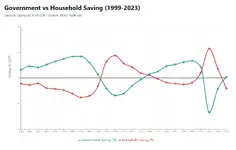
This is visible if you look at the sectoral balances. When the public sector runs smaller deficits or surpluses, the private sector must, by definition, take on more debt to keep activity going.
1769578427386.webp
That’s why the Clark - Cullen period coincided with rising private borrowing. It looked prudent on public balance sheets, but it quietly loaded risk elsewhere. We’re now living with the consequences of that model.
So when people worry about Govt debt as a solvency issue, they’re looking in the wrong place. The real danger is an economy where private debt keeps rising while public investment keeps falling.

That’s also why the current Govt’s approach is so damaging. Cutting public pipelines and relying on markets where capacity is already stretched doesn’t reduce risk. It shifts pressure onto already indebted households and firms and shrinks productive capacity further.
This isn’t about β€œgovt versus private”. It’s about sequencing and balance. Public investment is what expands the base the private sector builds on. When that foundation is weak, private growth becomes debt heavy and fragile. When it’s strong, private investment is cheaper, more productive, and more resilient.
That’s the core issue. Not whether the Govt can afford to invest, but what happens when it doesn’t.
 
Last edited:

NZWarriors.com

An example of capacity is the Labour policy of 3 free doctors visits per year requiring 2 1/2 million more doctors visits when there already no capacity.

Surely you need the capacity growing in line with the funding rather than promising and hoping the capacity will come?

It’s another Labour failed promise before it’s even started. Copy of the 100,000 Kiwibuild.

You can say we’ve under invested in doctors for years and we just need to spend the money but it also takes planning and years of training to address rather than just promising the unachievable?

That’s a fair critique in one sense, and you’re right about sequencing. You can’t announce higher use of a system that’s already stretched without a credible plan to expand supply alongside it.
I also haven’t read Labour’s GP policy, so I don’t know whether they’re pairing the free visits proposal with measures to expand primary care capacity through training, retention, or recruitment.
That said, your broader point stands. Training takes time, workforce planning matters, and implementation is where Labour has fallen over before. KiwiBuild, as you point out, is the obvious example.
I’m happy to concede that Labour didn’t fully grasp the capacity constraints early on. Targets were set before the planning, delivery, and workforce systems were ready, and execution suffered.

But that critique doesn’t actually support the conclusion you’re drawing.
The lesson from KiwiBuild isn’t that public involvement was wrong. It’s that capacity expansion wasn’t treated as the primary task early enough. Once you accept that, the answer isn’t β€œdon’t promise things” or β€œlet the private sector handle it.” It’s that governments need to invest earlier, more steadily, and more deliberately in the systems that deliver outcomes.
Where Labour does deserve some credit is that it at least identified housing supply as a structural problem and tried to intervene. KiwiBuild failed as a flagship policy, but the later scaling of Kainga Ora was a genuine improvement. It rebuilt delivery capability, learned by doing, and produced housing at a scale well above previous governments. Not at the headline levels promised, but materially more than before.

That contrasts sharply with the current coalition. Their assumption is that the private sector will somehow generate growth while public investment is cut in the pursuit of a surplus. That ignores the reality that private activity depends on public pipelines, skills, infrastructure, and demand. You don’t get expansion by withdrawing those foundations.
On healthcare, the same logic applies. Free GP visits without parallel workforce expansion would fail. But cutting funding, freezing hiring, and shrinking training pipelines while pointing at capacity limits is the same sequencing error in reverse. You end up saying β€œwe can’t do X because capacity is tight” while actively making capacity tighter.

So yes, capacity has to grow in line with policy. But capacity doesn’t grow on its own. As I previously pointed out treating today’s shortages as a reason not to act, rather than a reason to invest earlier and more consistently, just locks the system into permanent scarcity.
That’s the core mistake.
 
I get why Clark and Cullen stand out, but I think this is where the frame still slips.
I regard them as successful because:

- they had a plan around the knowledge economy and funded it (upskilling workforce capacity). University and training trended up.
- they invested heavily in infrastructure
- invested heavily in state housing
- introduced working for families
- introduced the super fund
- pro R&D
- basically addressed underinvestment in the 90’s

All while maintaining a good overall economy, running surpluses and paying down debt.

This is the standard for me. Solid private sector and using it to invest heavily in the public sector.
 
Back
Top Bottom