I get why that period looks successful on the surface, and I don’t disagree that some of those policies were positive moves.
Yes, the Clark Govt invested in universities and training, lifted infrastructure and state housing spending, introduced Working for Families, set up the Super Fund, and talked up R&D. Those weren’t nothing. But scale and sequencing matter, and this is where I think the story gets misread.
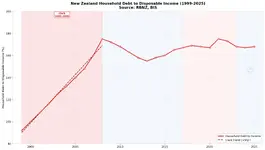
That model was a false economy. Public debt fell largely because private debt rose. It looked prudent at the time, but it relied on households carrying more and more of the risk.
Once that capacity is used up, the model stops working. That’s where we are now. With private debt already high, even modest Govt pullbacks don’t create efficiency, they create contraction.
View attachment 15580
This shows the constraint clearly. Household debt rose much faster than incomes through the 2000s. Growth was being supported by households taking on more debt, not by rising wages or productivity. Once that ratio stops climbing, the growth engine stalls.
What made the 2002–2008 period look strong wasn’t uniquely good management. It was a specific mix of conditions: relatively low household debt at the start, rapid private credit growth largely through housing, strong population growth and immigration, and a fairly stable global backdrop. That made it possible to run surpluses while the private sector was borrowing heavily. The state wasn’t building a new growth engine; it was largely riding the one already in place.
So when you say they “used a solid private sector to invest heavily in the public sector,” the causality is partly reversed. Private expansion came first, driven by debt rather than productivity, and public investment mostly stayed within orthodox surplus and debt limits.
As I’ve been explaining in the earlier replies, orthodox economics still treats Govt finance as if the state were financially constrained like a household. Reading surpluses and falling public debt as signs of economic health, without looking at what’s happening to productive capacity underneath, leads to the wrong conclusions about what’s actually sustainable.
View attachment 15582
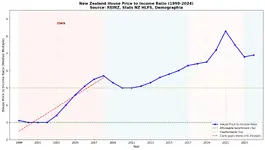
You can also see where that debt went. House prices ran well ahead of incomes, which tells you a large share of the borrowing flowed into housing and land rather than into expanding productive capacity.
That’s why so much of NZ’s growth has been people buying and selling houses to each other, rather than building lasting productive capacity.
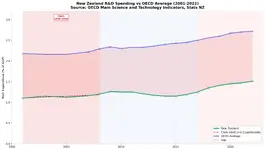
This also shows up when you look at innovation.
View attachment 15581
Despite the rhetoric, NZ’s R&D spending stayed around half the OECD average throughout that period. There was some growth, but it was incremental and never closed the gap. Being pro-innovation in principle isn’t the same as investing at a scale that actually shifts the economy’s productive base.
The common thread across housing, infrastructure, skills, and R&D is that public investment mostly ran at or near maintenance levels, while growth was driven by a private credit boom, especially in housing. That can work for a while, but it leaves you with high household debt and very little spare capacity when conditions change.
The proof is what followed. Once household debt stopped rising, growth slowed. Govts then tried to repeat the same model by pulling back further and hoping the private sector would do more with less. It can’t. We’re now left with higher private debt, deferred infrastructure, stressed public services, and far less room to absorb shocks.
So the lesson from that era isn’t “this is the standard to return to.” It’s that the model worked while households still had room to take on more debt. That space is gone.