An article I came across following one of Trump's executive orders
We all know that Congress has “the power of the purse,” but what if he disagrees with the programs they decide to fund? What happens if the president doesn’t want to spend the money Congress allocates? Can he refuse to spend it?
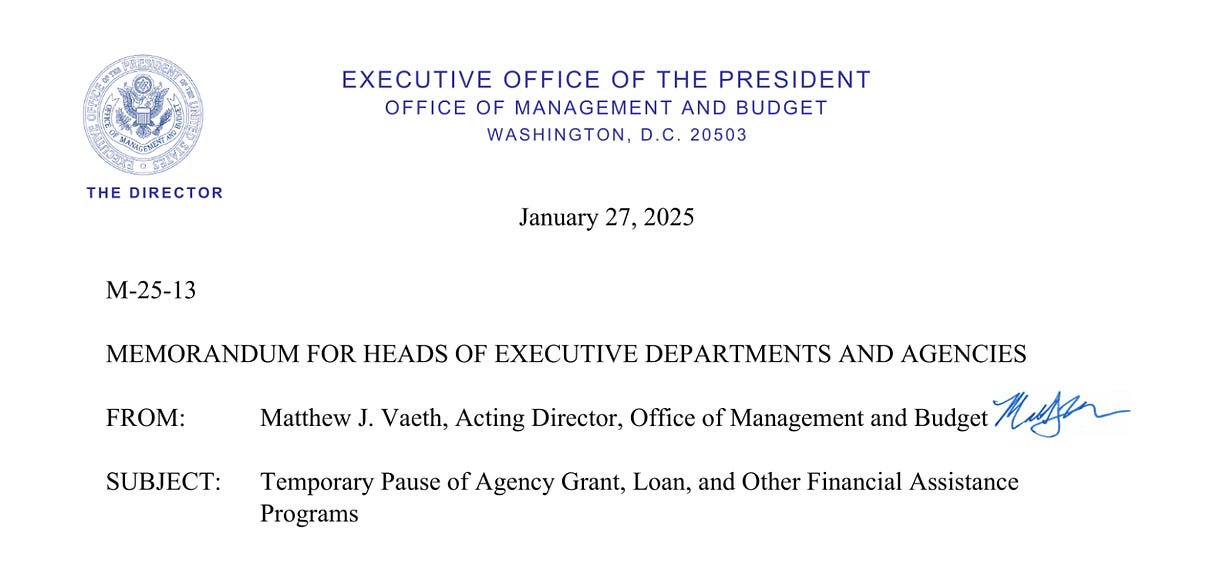
That’s how we started the day, with the fallout from a memo issued by Matthew J. Vaeth, the acting director of the Office of Management and Budget (OMB) Monday night, which you can read in full here. It references a so-called duty of the executive branch “to align Federal spending and action with the will of the American people,” before unloading this rather incredible sentence: “The use of Federal resources to advance Marxist equity, transgenderism, and green new deal social engineering policies is a waste of taxpayer dollars that does not improve the day-to-day lives of those we serve.”
So, what was the plan? OMB ordered executive branch agencies “to identify and review all Federal financial assistance programs and supporting activities” for ideological purity, and in the meantime, they were supposed to stop payment. The memo directed each agency to “complete a comprehensive analysis of all of their Federal financial assistance programs to identify programs, projects, and activities” that run afoul of any of Trump’s executive orders.
The agencies were also ordered to “temporarily pause all activities related to obligation or disbursement of all Federal financial assistance, and other relevant agency activities that may be implicated by the executive orders,” while the review is underway. That included programs such as “financial assistance for foreign aid, nongovernmental organizations, DEI, woke gender ideology, and the green new deal.” Federal aid spending was slated to come to a halt the next day, Tuesday. By Tuesday morning, there were reports that Medicaid portals were shut down. Access to funding that supported programs for people experiencing homelessness, Head Start, and Meals on Wheels was reported to be offline.
The massive confusion over which programs were impacted seemed to culminate in a combative first press conference by Trump’s newest spokeswoman, Karoline Levitt, during which it became clear that the poorly worded, confusing memo issued by OMB required additional clarification. Then, a lawsuit filed by the National Council of Nonprofits caused federal district Judge Loren AliKhan to temporarily block Trump’s plan to stop spending so she could hold a hearing on Monday to consider whether she should issue a temporary restraining order that could block the freeze for an additional two weeks. The outcome of that hearing will turn on whether the plaintiff groups challenging the Trump administration’s plans can show that they will be irremediably harmed by the measure.
That leaves us with the question, can a president unilaterally substitute their own funding decisions for those of Congress? The answer is, they can’t. The attempt to do so is called impoundment, and it’s prohibited by the 1974 Impoundment Control Act. The Act bars presidents from withholding funds from congressionally mandated programs they oppose.
The Impoundment Control Act, like much of the legislation requiring presidents to follow the law, was passed in reaction to the Nixon presidency. It effectively ended a president’s power to impound funds. The year following its passage, the Supreme Court held in Train v. City of New York that even without the Act, presidents lack the authority to impound funds. Train reaffirmed the clear grant of the power of the purse to Congress in the Constitution.
The only way Trump can proceed with impoundment is if the Act is unconstitutional and Train is reversed.
In December, Trump nominated Washington, D.C., lawyer Mark Paoletta to retread his role during Trump’s first administration as OMB’s General Counsel. Previously, Paoletta authored an article titled “The President’s Constitutional Power of Impoundment,” in which he argued that “Since the Founding, it has been understood that Article II vests the President with authority to decline to spend the full amount of an appropriated fund.” Paoletta argues that the impoundment power is “grounded in the text and structure of the Constitution and supported by centuries of history and practice”—precisely the type of argument the Supreme Court has used to buy into dramatic reversal of precedent in other areas, like abortion.
We end the day with this looming constitutional confrontation taking shape. Could it be that easy? Can Trump simply yank the funding for any programs he believes are “woke” or in pursuit of a “green new deal” (that never became the law in any event)? Can Trump rip up protections for the LGBTQ community, and beyond that, for any at-risk group he’s at odds with, because the Supreme Court is going to restore his impoundment power? It’s possible that an impoundment case could make its way to the Court promptly, at least on the temporary stay order, and we could get an early inclination of how the Court is leaning later this year.
Elections have consequences.
[/td]
We all know that Congress has “the power of the purse,” but what if he disagrees with the programs they decide to fund? What happens if the president doesn’t want to spend the money Congress allocates? Can he refuse to spend it?
[td]
[/td]
[/td]
That’s how we started the day, with the fallout from a memo issued by Matthew J. Vaeth, the acting director of the Office of Management and Budget (OMB) Monday night, which you can read in full here. It references a so-called duty of the executive branch “to align Federal spending and action with the will of the American people,” before unloading this rather incredible sentence: “The use of Federal resources to advance Marxist equity, transgenderism, and green new deal social engineering policies is a waste of taxpayer dollars that does not improve the day-to-day lives of those we serve.”
So, what was the plan? OMB ordered executive branch agencies “to identify and review all Federal financial assistance programs and supporting activities” for ideological purity, and in the meantime, they were supposed to stop payment. The memo directed each agency to “complete a comprehensive analysis of all of their Federal financial assistance programs to identify programs, projects, and activities” that run afoul of any of Trump’s executive orders.
The agencies were also ordered to “temporarily pause all activities related to obligation or disbursement of all Federal financial assistance, and other relevant agency activities that may be implicated by the executive orders,” while the review is underway. That included programs such as “financial assistance for foreign aid, nongovernmental organizations, DEI, woke gender ideology, and the green new deal.” Federal aid spending was slated to come to a halt the next day, Tuesday. By Tuesday morning, there were reports that Medicaid portals were shut down. Access to funding that supported programs for people experiencing homelessness, Head Start, and Meals on Wheels was reported to be offline.
The massive confusion over which programs were impacted seemed to culminate in a combative first press conference by Trump’s newest spokeswoman, Karoline Levitt, during which it became clear that the poorly worded, confusing memo issued by OMB required additional clarification. Then, a lawsuit filed by the National Council of Nonprofits caused federal district Judge Loren AliKhan to temporarily block Trump’s plan to stop spending so she could hold a hearing on Monday to consider whether she should issue a temporary restraining order that could block the freeze for an additional two weeks. The outcome of that hearing will turn on whether the plaintiff groups challenging the Trump administration’s plans can show that they will be irremediably harmed by the measure.
That leaves us with the question, can a president unilaterally substitute their own funding decisions for those of Congress? The answer is, they can’t. The attempt to do so is called impoundment, and it’s prohibited by the 1974 Impoundment Control Act. The Act bars presidents from withholding funds from congressionally mandated programs they oppose.
The Impoundment Control Act, like much of the legislation requiring presidents to follow the law, was passed in reaction to the Nixon presidency. It effectively ended a president’s power to impound funds. The year following its passage, the Supreme Court held in Train v. City of New York that even without the Act, presidents lack the authority to impound funds. Train reaffirmed the clear grant of the power of the purse to Congress in the Constitution.
The only way Trump can proceed with impoundment is if the Act is unconstitutional and Train is reversed.
In December, Trump nominated Washington, D.C., lawyer Mark Paoletta to retread his role during Trump’s first administration as OMB’s General Counsel. Previously, Paoletta authored an article titled “The President’s Constitutional Power of Impoundment,” in which he argued that “Since the Founding, it has been understood that Article II vests the President with authority to decline to spend the full amount of an appropriated fund.” Paoletta argues that the impoundment power is “grounded in the text and structure of the Constitution and supported by centuries of history and practice”—precisely the type of argument the Supreme Court has used to buy into dramatic reversal of precedent in other areas, like abortion.
We end the day with this looming constitutional confrontation taking shape. Could it be that easy? Can Trump simply yank the funding for any programs he believes are “woke” or in pursuit of a “green new deal” (that never became the law in any event)? Can Trump rip up protections for the LGBTQ community, and beyond that, for any at-risk group he’s at odds with, because the Supreme Court is going to restore his impoundment power? It’s possible that an impoundment case could make its way to the Court promptly, at least on the temporary stay order, and we could get an early inclination of how the Court is leaning later this year.
Elections have consequences.
[/td]