Politics πŸ—³οΈ NZ Politics

Sex education is one example. There are some countries that look like their birth rate has gone down, but in reality, the teen pregnancy rate has gone down and couples are having children later in life. This means there is a lag/delay in the birth rate but after 8-10 years it will be normal again.

Thats a pretty big claim and I have seen zero evidence to support this.
 
Thats a pretty big claim and I have seen zero evidence to support this.
I have receipts.


Teen pregnancy rates in New Zealand have decreased significantly over the last decade, with births to teenage mothers (15–19 years) more than halving. As of 2022, there were 1,719 births to teenagers (11 per 1,000) compared to 3,786 in 2012 (25 per 1,000), marking a 55% decline and a long-term downward trend.
Stats NZ
Stats NZ
+2
Key Trends and Data
Rapid Decline: The teen birth rate in 2016 was 16 per 1,000, half of the 2008 rate of 33, representing a consistent decline.
Long-Term Change: Teenage births peaked in 1972 with 9,150 births.
 
I have receipts.


Teen pregnancy rates in New Zealand have decreased significantly over the last decade, with births to teenage mothers (15–19 years) more than halving. As of 2022, there were 1,719 births to teenagers (11 per 1,000) compared to 3,786 in 2012 (25 per 1,000), marking a 55% decline and a long-term downward trend.
Stats NZ
Stats NZ
+2
Key Trends and Data
Rapid Decline: The teen birth rate in 2016 was 16 per 1,000, half of the 2008 rate of 33, representing a consistent decline.
Long-Term Change: Teenage births peaked in 1972 with 9,150 births.
Sorry I should have clarified, less teen pregnancy I believe, i don’t believe that couples are making up for it later. I was under the impression that fertility rates are down across ALL cohorts.
 
Sorry I should have clarified, less teen pregnancy I believe, i don’t believe that couples are making up for it later. I was under the impression that fertility rates are down across ALL cohorts.
Yes they are but at the median range it's the most stable and went down the least, which means by scaling comparisons it's gone up.

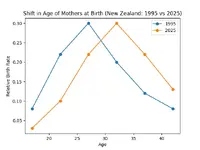
NZ birth rates have shifted significantly since 1995, characterized by a major decline in teenage/young parent fertility and a rise in the median maternal age, which reached 31.7 years in 2025 compared to 28.6 in 1995. Fertility rates for women under 25 have halved, with only 14% of births to this group in 2025 versus 28% in 1995.
Stats NZStats NZ +2
Key Birth Rate Changes by Maternal Age (1995 vs. 2025/Recent):
  • Under 25: Births to mothers under 25 reached a record low in 2025 (14% of all births).
  • 15–19 Years: Fertility plummeted from 33.39 per 1,000 women in 1995 to 9.09 in 2025.
  • 20–24 Years: Rates dropped drastically from 83.01 in 1995 to 42.08 in 2025.
  • 25–29 Years: Rates decreased from 123.36 in 1995 to 81.63 in 2025.
  • 30–34 Years: This age group has become the peak childbearing age, with rates moving from 106.15 in 1995 to 102.7 in 2025, becoming more stable compared to younger groups.
  • 35–39 Years: Rates increased from 43.5 in 1995 to 61.72 in 2025.
1776927205307.webp
 
Yes they are but at the median range it's the most stable and went down the least, which means by scaling comparisons it's gone up.

NZ birth rates have shifted significantly since 1995, characterized by a major decline in teenage/young parent fertility and a rise in the median maternal age, which reached 31.7 years in 2025 compared to 28.6 in 1995. Fertility rates for women under 25 have halved, with only 14% of births to this group in 2025 versus 28% in 1995.
View attachment 17048Stats NZ +2
Key Birth Rate Changes by Maternal Age (1995 vs. 2025/Recent):
  • Under 25: Births to mothers under 25 reached a record low in 2025 (14% of all births).
  • 15–19 Years: Fertility plummeted from 33.39 per 1,000 women in 1995 to 9.09 in 2025.
  • 20–24 Years: Rates dropped drastically from 83.01 in 1995 to 42.08 in 2025.
  • 25–29 Years: Rates decreased from 123.36 in 1995 to 81.63 in 2025.
  • 30–34 Years: This age group has become the peak childbearing age, with rates moving from 106.15 in 1995 to 102.7 in 2025, becoming more stable compared to younger groups.
  • 35–39 Years: Rates increased from 43.5 in 1995 to 61.72 in 2025.
View attachment 17049

Thanks. so all but 1 has fallen. That's pretty dire considering 20-29 peak fertility cohort has fallen by drastic amounts, and Im not sure the below makes up for those losses.
  • 35–39 Years: Rates increased from 43.5 in 1995 to 61.72 in 2025.
 
Yes they are but at the median range it's the most stable and went down the least, which means by scaling comparisons it's gone up.

NZ birth rates have shifted significantly since 1995, characterized by a major decline in teenage/young parent fertility and a rise in the median maternal age, which reached 31.7 years in 2025 compared to 28.6 in 1995. Fertility rates for women under 25 have halved, with only 14% of births to this group in 2025 versus 28% in 1995.
View attachment 17048Stats NZ +2
Key Birth Rate Changes by Maternal Age (1995 vs. 2025/Recent):
  • Under 25: Births to mothers under 25 reached a record low in 2025 (14% of all births).
  • 15–19 Years: Fertility plummeted from 33.39 per 1,000 women in 1995 to 9.09 in 2025.
  • 20–24 Years: Rates dropped drastically from 83.01 in 1995 to 42.08 in 2025.
  • 25–29 Years: Rates decreased from 123.36 in 1995 to 81.63 in 2025.
  • 30–34 Years: This age group has become the peak childbearing age, with rates moving from 106.15 in 1995 to 102.7 in 2025, becoming more stable compared to younger groups.
  • 35–39 Years: Rates increased from 43.5 in 1995 to 61.72 in 2025.
View attachment 17049

Also 15-19 is a strange grouping for them to have...
 
If you could provide me with some websites or at least stats
Ncea level 3 pass rates: 2021 - 65%, 2022 - 67%, 2023 -67.7%, 2024 - 68.2%, 2025 - 70.4% - steady improvement

Attendance Term 1 2023: 59.0%; Term 1 2024: 61.4%; Term 1 2025: 65.9% - Many more kids in school

Chronic absence - 2023 Term 2: 12.5%; 2025 Term 2: 9.3% - less chronic absences


Introduced repeatable designs for classrooms halving the cost of building a new classroom, and delivering 430 new classrooms since 2024 - more schools for cheaper

Add to that banning open classrooms, cellphones, 1hr per day on reading, writing, maths, etc
 
Yes they are but at the median range it's the most stable and went down the least, which means by scaling comparisons it's gone up.

NZ birth rates have shifted significantly since 1995, characterized by a major decline in teenage/young parent fertility and a rise in the median maternal age, which reached 31.7 years in 2025 compared to 28.6 in 1995. Fertility rates for women under 25 have halved, with only 14% of births to this group in 2025 versus 28% in 1995.
View attachment 17048Stats NZ +2
Key Birth Rate Changes by Maternal Age (1995 vs. 2025/Recent):
  • Under 25: Births to mothers under 25 reached a record low in 2025 (14% of all births).
  • 15–19 Years: Fertility plummeted from 33.39 per 1,000 women in 1995 to 9.09 in 2025.
  • 20–24 Years: Rates dropped drastically from 83.01 in 1995 to 42.08 in 2025.
  • 25–29 Years: Rates decreased from 123.36 in 1995 to 81.63 in 2025.
  • 30–34 Years: This age group has become the peak childbearing age, with rates moving from 106.15 in 1995 to 102.7 in 2025, becoming more stable compared to younger groups.
  • 35–39 Years: Rates increased from 43.5 in 1995 to 61.72 in 2025.
View attachment 17049
Good stats. Are there any that show how many children those canvassed already have in an earlier iteration.
 
Ncea level 3 pass rates: 2021 - 65%, 2022 - 67%, 2023 -67.7%, 2024 - 68.2%, 2025 - 70.4% - steady improvement

Attendance Term 1 2023: 59.0%; Term 1 2024: 61.4%; Term 1 2025: 65.9% - Many more kids in school

Chronic absence - 2023 Term 2: 12.5%; 2025 Term 2: 9.3% - less chronic absences


Introduced repeatable designs for classrooms halving the cost of building a new classroom, and delivering 430 new classrooms since 2024 - more schools for cheaper

Add to that banning open classrooms, cellphones, 1hr per day on reading, writing, maths, etc
So NCEA level 3 going up happened under both governments. But this government said it's not good enough and cancelled NCEA. The biggest thing is what's the NCEA level 3 pass rate for low decile schools and the kicker, how many actually try to do NCEA lvl3 compared to how many began in yr9.

The 1hr reading writing math is a red herring because what were primary schools doing if they weren't doing that previously? All schools I know were doing that.

They also didn't ban open classrooms, this government said they won't build any more. Open classroom still exists, go visit westmere, Freeman's Bay, western springs etc.

Making classrooms cheaper to build could mean worse classrooms. Look at school lunches....
 
I get that, but there's a big difference between 15yr olds getting pregnant and 18y old ones. Would have though policies designed at each would be diametrically opposed
It's what stats NZ has made. Each group has 5 years of ages. While I would agree that at 18/19 they are more likely to know what they are doing, they are still really just kids. A lot of 18 year olds are still at school and might still get sexual education. But I think we're talking semantics here/off track from main conversation.
 
No, was thinking more about the situation here whereby the more children you have, illegitimate or not, gets you more buck folding.
Maybe it's late but I have no idea what you're asking lol. What's buck folding?

Each birth is counted separately
The mother’s age at the time of that specific birth is what matters

So the unit is β€œbirths”, not β€œwomen”

πŸ‘Ά Example

If one woman has:

Baby at age 24 β†’ counted in 20–24 group
Baby at age 29 β†’ counted in 25–29 group
Baby at age 34 β†’ counted in 30–34 group

πŸ‘‰ She appears once in three different age groups
πŸ‘‰ Because she had three separate births
 
Back
Top Bottom