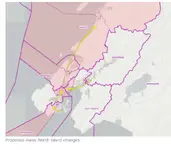
Looks like some major changes to the Electorates in Wellington as recommended by the Representation Commission with the North Island about to lose a seat based on the last census information. I doubt that Labour will be too happy as it looks like it will be the end of either Ohariu or Mana.
Electorate boundary proposals: Three lower North Island seats abolished, two created
Major changes are being proposed to electorates in the lower North Island, resulting in the disappearance of one seat.
The key announcement coming out of the review of electorate boundaries by the Representation Commission is a proposal to create two new electorates, while three are proposed to be removed, resulting in a net reduction of one.
These proposed changes take place in the lower North Island around Wellington. The two new electorates — proposed to be called Kenepuru and Kāpiti — will be created from sections of Ōhāriu, Mana and Ōtaki. Those three electorates will be removed.
Currently, Ōhāriu and Mana are held by Labour’s Greg O’Connor and Barbara Edmonds, respectively. The Ōtaki seat is held by National’s Tim Costley. The
Herald has contacted the MPs for comment.
To accommodate these proposed changes, the commission wants to see Wellington’s Rongotai gain areas of Mt Cook and Brooklyn suburbs. Wellington Central loses those and moves northwards into the hill suburbs of Wadestown, Ngaio and Khandallah.
The Hutt South electorate expands to take in part of Newlands, while Remutaka moves southward to incorporate a small area around Epuni.
The commission was required to reduce the number of electorates in the North Island by one, due a change in population data at the last Census.
In a release today, chairman Judge Kevin Kelly said the commission had addressed this “in the lower North Island where the populations of all the current electorates are below the target quota”.
“This change, coupled with some significant population changes elsewhere, has resulted in relatively substantial shifts in most electorate boundaries in the North Island, and particularly in the lower North Island and the Auckland region.”
The commission said it decided to remove one electorate from the lower North Island rather than Auckland as all electorates in the lower North Island are below or well below the target population quota. They are projected to fall further.
“Population is growing in Auckland, and if an electorate was removed, it’s possible another would have to be added back at the next boundary review,” the commission said.
“Adjusting the electorates in the lower North Island best reflects the current population distribution across the North Island and should reduce the need for the next Representation Commission to make substantial changes.”
Other key changes
Overall, 22 of the 72 general electorates are unchanged. About 736,100 people in the North Island general electorates, 29,900 people in the South Island general electorates, and 3300 people in the Māori electorates are affected by the proposed changes.
In West Auckland, New Lynn, Kelston and Te Atatū are proposed to be reconfigured and renamed Waitākere, Glendene and Rānui.
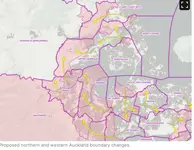
In South Auckland, the boundaries of Panmure-Ōtāhuhu is proposed to be moved south and is proposed to be renamed Ōtāhuhu.
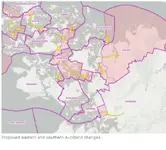
The Tauranga and Bay of Plenty electorates will be reconfigured — with Tauranga in the west and Bay of Plenty in the east. Bay of Plenty will be renamed Mt Maunganui.
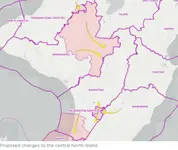
In the central North Island, Whanganui extends northwards to incorporate Raetihi, Ohakune, Waiouru, Waimarino, and Ōwhango. Taranaki-King Country gains a small area around and including Taumarunui. Rangitīkei extends southwards to incorporate Foxton / Foxton Beach, Shannon, Waitārere and Levin. Wairarapa expands slightly on its western edge to include the town of Ashhurst on the outskirts of Palmerston North.
In the South Island, the electorate of Selwyn is described as one of the fastest-growing electorates and adjustments have been made so that Christchurch electorates take in more population.
In the Māori electorates, an adjustment is proposed to the boundary between Ikaroa-Rāwhiti and Te Tai Tonga in Lower Hutt. There are no changes proposed for the other five Māori electorates.
Click here to use an interactive map of the proposed changes.
The Representation Commission regularly redraws the
boundaries of electorates to ensure they have roughly the same number of people in each. This is done after each five-year population Census.
As well as population figures, the commission also considers factors such as communities of interest, infrastructure that links communities, topographic features and projected variations in the population over the next five years.
The commission met in February to set the proposed boundaries, which are now being released for public submissions.
The public has until April 27 to highlight any objections, and then until May 21 to submit any counter-objections. There are public hearings between June 9 and 18, before the final boundaries are released on August 8.
Before Tuesday’s announcement, Prime Minister Christopher Luxon said it was an “independent process” and he believed National would be “well placed” and “compete very strongly” at next year’s election.
While most of the members of the Representation Commission are senior officials, such as the Chief Electoral Officer, the Government and the Opposition each have a representative. Former National MP Roger Sowry, who has been on the commission before, represented the Government, while former Labour leader Andrew Little represented the Opposition.
How the commission is made up has previously been criticised as not fitting an MMP environment and only reflecting the perspectives of the two largest parties on a critical election matter.
Act leader David
Seymour told the
Herald last year he wasn’t making a personal criticism of those nominated to be on the panel, but called the system “out of date”.
“One person deciding electoral boundaries that affect all parties and could decide the outcome of the election is a recent Labour leader, and the other a former National MP,” he said.
“That might have been appropriate in the New Zealand of yesterday, but today we’d expect the rules of the election to be made in a more politically neutral way.”
Other electorate changes have also been announced.

www.nzherald.co.nz


 www.rnz.co.nz