Politics πŸ—³οΈ NZ Politics

Government spending doesn’t come from taxes.
Operationally, when the NZ Govt spends, Treasury instructs the RBNZ to credit settlement accounts at commercial banks.
New money is created at the point of spending.
Taxes withdraw money from the economy after the spending.
Bonds (β€œGovt debt”) manage the liquidity in the banking reserves system that spending creates. This is part of monetary policy.
Critically, neither taxes nor bonds fund spending.

The sequencing is explicit in RBNZ documentation.
Orthodox fiscal framing gets this sequencing wrong, which is why the debate keeps getting stuck on β€œwho pays” instead of β€œwhat’s possible”.

The Govt issues the currency. It can always meet obligations denominated in NZD.
The constraint isn’t tax revenue, gentailer dividends, or shareholder payouts.
It’s real resources: engineers, materials, project management capability, grid integration, and delivery capacity.

So the $14 billion Lake Onslow question isn’t β€œwhere does the money come from?” It’s whether it’s a good project and whether NZ has, or is willing to build, the capacity to deliver it without creating bottlenecks.
It's a resource and capability question, not a taxpayer one.
If the government doesn't need tax to pay it's bills, why do I pay 15% GST on everything I buy or income tax or why did I get a "tax cut" as a landlord?

Why? Because what you're suggesting is one stream of money available to a government but overly relying on one stream such as the bond market is inflationary.... which is why we went into recession to battle the high inflation the COVID stimulus caused.

In that case, I wonder what you'll think when your power bill goes up to pay for it? 'I'm not paying this extra because the government doesn't need the money'.

The problem with MMT is that you need to keep on increasing taxes to ensure that the money released by the government to repay bonds and the interest due, isn't inflationary.


Here's what happens when a government commits itself to the path of MMT...


What you're suggesting isn't working for Japan where they're now having to reduce government spending after a stimulus which led to record numbers of investors leaving the Japanese bond market.
 
Last edited:
If the government doesn't need tax to pay it's bills, why do I pay 15% GST on everything I buy or income tax or why did I get a "tax cut" as a landlord?

Why? Because what you're suggesting is one stream of money available to a government but overly relying on one stream such as the bond market is inflationary.... which is why we went into recession to battle the high inflation it caused.

In that case, I wonder what you'll think when your power bill goes up to pay for it? 'I'm not paying this extra because the government doesn't need the money'.

What you're suggesting isn't working for Japan where they're now having to reduce government spending after a stimulus which led to record numbers of investors leaving the Japanese bond market?
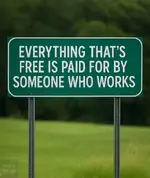
Here's a truism Mike
 

Attachments

  • image-35.webp
    image-35.webp
    24.9 KB · Views: 0
Government spending doesn’t come from taxes.
Operationally, when the NZ Govt spends, Treasury instructs the RBNZ to credit settlement accounts at commercial banks.
New money is created at the point of spending.
Taxes withdraw money from the economy after the spending.
Bonds (β€œGovt debt”) manage the liquidity in the banking reserves system that spending creates. This is part of monetary policy.
Critically, neither taxes nor bonds fund spending.
I understand your points, but I think the first and last line are a bit misleading

Government spending is funded initially via the Treasury and banks, and interest / principal repaid via taxes. If there is insufficient taxing (current or forecast), then the whole cycle goes out of whack and funding isn't sustainable

So while specific projects aren't initially "funded" by tax money on hand, eventually taxes need to pay them off (or cover their interest and hope the economic growth continues to cover them)

Therefore you can't look at an infrastructure project in isolation without considering how the tax base will service or repay the funding. Or look at reallocating funding from elsewhere to ensure interest and principal is addressed

And if you don't remove the money from the economy via taxes, inflation sets in
 
The math on registrations is right, but the conclusion is missing one important piece of context: Maori seats can be contested by any party.
They’re not β€œleft seats” built into the system. If a party’s policies don’t attract Maori votes, that’s a party policy choice.

It’s also worth understanding the MMP system, which was brought in to better balance representation.
Electorate seats are direct representation and are treated as untouchable; list MP proportionality is adjusted around them, not through them.
Because MMP correctly prioritises electorate seats, you can get what’s called an overhang.
An overhang happens when a party wins electorate seats but doesn’t reach the party vote threshold.
The system doesn’t remove electorate MPs, because they were directly elected. Instead, Parliament becomes slightly larger.

This has happened 4 times since MMP started in 1996, and in 3 of those cases the overhang seats supported the Govt that formed.
Twice they supported a National led Govt (2008 and 2011), and once they supported a Labour led Govt (2005).
The other time was 2023, and the party sits in opposition. So if we’re being nitpicky, the seat discrepancy so far has actually benefited the β€œright” more than the β€œleft”.
How many times have parties on the right won a māori seat? BTW, the māori party not being part of a Labour led government didn’t put them on the β€œright” of the political spectrum…. It just meant Labour didn’t need their numbers to form a government like the Greens weren’t on the β€œright” either with Arden’s second government.

My feeling is that MMP should mean the β€œmix” of the proportionality between all seats should be the same.

An overhung seat has nothing to do with māori seats only needing an average of 45k voters while General seats have 55k.

I’d be just as concerned, in fact, more so, if the proportionality for blue seats was changed by say combining the 55k eligible voters in Tamaki with the 55k eligible voters in Epsom and instead creating three 36k electorates favouring the right. Or if the voters from Panmure-Otahuhu (54k),
Mangere (54k) and Manurewa (55k) were combined and then split into two electorates with 80k voters. Why? Because it affects the proportionality and either of those two would give an unfair advantage to the right. But, using your logic of not worrying about proportionality, you’d be okay with that? Or is your logic showing a political biased I wonder?
 
This was always the aim of this hard right government

Māori wrecked if for themselves

- having to consult 17 iwi to get an existing domestic level septic system reconsented
 
This was always the aim of this hard right government

As someone who has worked with the RMA since 1991, removing the Treaty and the need to consult with māori is absolutely wrong.

What needed to happen was it streamlined which māori iwi/hapu the applicants/consultants/council dealt with. Having to get 17 iwi in the Auckland area to agree with the positioning of a house which might have been within 50m of an historic food pit is wrong... but consultation needs to occur with the iwi with a close tie to that particular piece of land.
 
Māori wrecked if for themselves

- having to consult 17 iwi to get an existing domestic level septic system reconsented
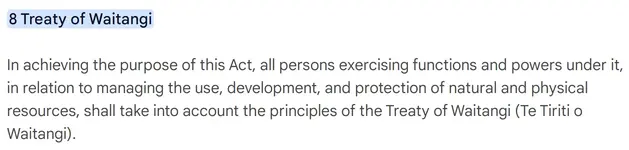
māori never "wrecked it for themselves".... Section 8 of the RMA said that consultation has to take place.....

1770800701771.webp

The issue isn't with māori consulting on applications.... it's how the Council's have interrupted which māori iwi should be consulted. Iwi can't "contract" their way out of the responsibilities Councils have put on to them.
 
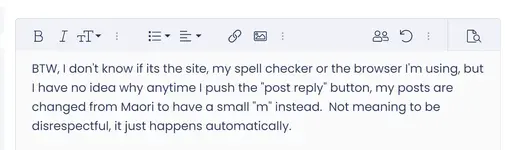
BTW, I don't know if its the site, my spell checker or the browser I'm using, but I have no idea why anytime I push the "post reply" button, my posts are changed from māori to have a small "m" instead. Not meaning to be disrespectful, it just happens automatically.

Here's a screen shot of the above before I post it.....

1770801210658.webp
 
Maori never "wrecked it for themselves".... Section 8 of the RMA said that consultation has to take place.....

View attachment 15746

The issue isn't with Maori consulting on applications.... it's how the Council's have interrupted which Maori iwi should be consulted. Iwi can't "contract" their way out of the responsibilities Councils have put on to them.
And iwi individually can choose to have an interest or not in insignificant applications. $800 to decide if an interest is wrought if the system.

Iwi have the legal right to blackmail money written into the RMA and I have the right to share my opinion based on the morals they have chosen.

And I’m just a small time nobody trying to renew an existing septic tank consent. Check out IKEA or Port of Tauranga… as pretty pro Māori doing business in Rotorua with a huge māori population that I have positive relations with - Māori have done it to themselves over the RMA.
 
Quite an accomplishment 20 years worth. Just have to look at him to know he hasn’t gone without. Makes me laugh with Luxon too, I reckon he’d be the first pm that’s gotten fatter in his time as pm in a while
Jacinda got bigger but she also lost it quite quickly. Bit like her public support I guess.
 
View attachment 15754


Sad to see for a child that had such tragic circumstances to his death
Kiwis are quick to criticise America for their lack of change about gun control but our lack of any substance progress protect our most vulnerable from something as simple as a curtain cord is discussing….

Preschooler’s blind-cord death: Politicians should have acted years ago – Audrey Young​


Welcome to Inside Politics. The death of a 3-year-old girl in Hāwera in 2023 might not immediately seem like a political story, but Tilly Cambie’s death after getting caught in a blind cord is not an isolated case. She is one of at least eight New Zealand children to have died in a similar way since 2006.

And despite the repeated recommendations of coroners, including today’s pleading from Coroner Bruce Hesketh, as reported by Open Justice, Government ministers and their departments have been way too slow to act.

It should be a pressing issue for Commerce and Consumer Affairs Minister Scott Simpson and the Ministry of Business, Innovation and Employment (MBIE), whose advice he relies on for mandatory regulation.

The Government can act swiftly when deaths occur at once, as recent weather events have shown. But on this matter, the record has been woeful. The ministry consulted on options in 2023 ranging from greater education to mandatory regulation similar to Australia. Nothing has happened.

β€œSadly, New Zealand still lacks mandatory regulations for corded window coverings, despite the number of deaths increasing ... I would encourage MBIE to make progress sooner rather than later,” Hesketh said.

He concurred with previous recommendations by coroners in 2018 and 2024, which concluded it was regrettable that New Zealand has not followed its closest international partners to impose any form of regulation because of the incidence of window cord deaths.

It is little wonder that Tilly’s mother, Courtney Cambie, is calling for some urgency from the Government.

β€œIf mandatory safety regulations had been in place, Tilly would still be with us today,” she said. β€œYou cannot β€˜educate’ away a design flaw, and no amount of parental vigilance can replace the professional, mandatory safety hardware that has been law in Australia, the US, and the UK for years.”

If Scott Simpson won’t act, which political party will listen?


View: https://www.facebook.com/share/v/1ByPYze8Tf/?mibextid=wwXIfr


I know many won’t think much of this woman but she makes some good points

Unfortunately she forgot to mention that Wellington Water are the owners and operators of all the potable water and sewage plants in the Wellington region.
The make up of Wellington Water is all the councils (reps) in the region including a Governance Board with Council reps. She may even be a rep seeing she is so concerned about it now.
Wellington Water sub contract out to Veolia for Ops and Maintenance.

So, in a weird old way, the accountability goes back to all the Councils, not that they would admit it

As for her other ideas, great if people are prepared to pay mega rates and higher taxes but unfortunately they're not. Most councils have enough trouble with inhouse lawnmowing and garden upkeep.
 
Turns out Veolia has form. Bad form.

I've known a few clients over the years who have dealt with Veolia in Papakura and WaterCare throughout the rest of Auckland. While it's rare to have people say something good about WareCare, I've never heard anything positive from those who have had to deal with Veolia.... including a number of developers who now won't touch any sections/land in Papakura.

You must be bad when developers prefer WaterCare!!!
 
Last edited:
Back
Top Bottom