
Little contract job, shops starting to be self reliant.Where have you been anyway, in the naughty corner?
Follow along with the video below to see how to install our site as a web app on your home screen.
Note: This feature may not be available in some browsers.
Little contract job, shops starting to be self reliant.Where have you been anyway, in the naughty corner?

I'm all for modernisation and democratisation of course. Fair regulation based on fact and standards.I can't find a NZ Standard for steam engines online either..... sometimes things just move on.... or need to be rewritten.
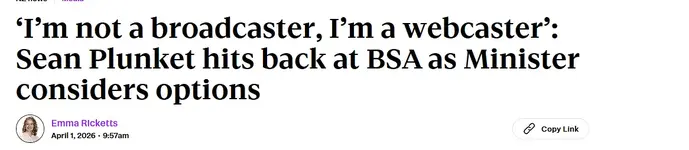
 www.stuff.co.nz
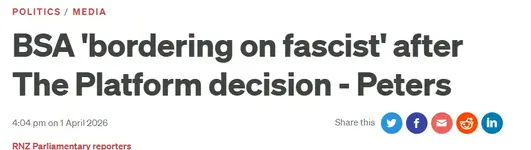
 www.rnz.co.nz
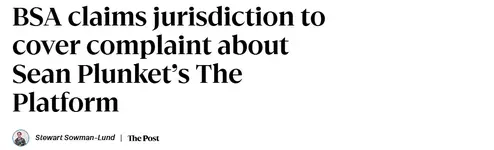

 www.thepost.co.nz

I'm all for modernisation and democratisation of course. Fair regulation based on fact and standards.
But I can guarantee that won't be the aim of this legislation.
All context though right? Apologies, I didn't have time to provide these bits - it centres around Sean Plunkett
View attachment 17219
Stuff: Latest breaking news | New Zealand
And of course the far right element both political and that of the Platform and it's ultra wealthy backers
View attachment 17220

BSA 'bordering on fascist' after The Platform decision - Peters
The Broadcasting Standards Authority has concluded an online media service "meets the Act's definition of 'broadcasting'", but the NZ First leader says it is going too far.
View attachment 17221
View attachment 17223
The Post
And Sean Fuckwit I mean Plunket - "The PM said he has my back"
View: https://www.facebook.com/theplatformnz/posts/sean-plunket-refreshes-the-prime-ministers-faulty-memory/1002688585616092/
Whatever it is you can guarantee it won't be to the benefit of ordinary new Zealanders or journalismIt's a bit ominous, are they replacing the BSA with some other framework covering social media?

Did you find that at a video store?
As a thought experiment, look at small rural towns across the country. Some are prosperous while others are in decline. Look at what makes them successful and extrapolate that across NZ vs other countries then wealthy and poverty stricken families:Systems of governance aren't tangential to poverty and wealth or whatever we're discussing are they? Seems pretty intrinsic to me. What's your ideal model?
Which industries should we be investing in to double NZ's GDP Wiz, traditional primary exporting, tourism, rocket tech, AI?As a thought experiment, look at small rural towns across the country. Some are prosperous while others are in decline. Look at what makes them successful and extrapolate that across NZ vs other countries then wealthy and poverty stricken families:
1 - Thriving towns are usually anchored to a strong, scalable industry. This is a trickle down where money spread through the town.
For NZ to be successful we need to prioritise successful industries with competitive advantages.
For families they need to prioritise education and attributes that make you highly employable.
2 - Towns with proactive councils, business groups, and iwi partnerships tend to punch above their weight. They chase investment, support events, and make it easier to build or start businesses. Others stagnate under risk-averse, resistant to change and/ or fragmented leadership.
Extrapolated to NZ, positivity and can do attitude. Currently we’re the risk averse resistant to change
For families get involved in the community, give everything a go and evolve with changes rather than resisting them.
3 - many invest in themselves with good cafes, decent schools, outdoor recreation, safety. That attracts remote workers, retirees, and tourism. Others don’t evolve and lose even their own locals to nearby centres.
In NZ case, pro industry, infrastructure, strong social support
In families case, invest in yourselves (education), housing, investments. Essentially live within your means and prioritise your future instead of living for the moment.
Just a little thought experiment!
That's called centralised planning. What you should do is have a permissible business environment accompanied with a capital markets friendly to start up risk and entrepreneurship. Neither of those things exist in NZ. Then the crap business will fail and the innovative ones will rise.Which industries should we be investing in to double NZ's GDP Wiz, traditional primary exporting, tourism, rocket tech, AI?

I think the Greens are going too far with the taxes.Here's a bit of tax information for you to consider.... if the Greens had their way, they would raise the total tax revenue from all sources from the current 33% of GDP to 45% of GDP ($200 billion tax revenue/$445 billion 2025 GDP).
Denmark taxes at that rate but they also allow oil and mineral exploration/extraction to fund it.... we don't.
In Asian cultures and I'm talking mostly Chinese culture which affected Japanese and Korean cultures, was that education was number 1. Educated people were the most prized and kings deferred to them. It was something to look up to. So even if you weren't educated, you admired and looked up to these people and wish your child was like that. European societies weren't like this because of a Royal/King/Caesar model where they were held high (chosen by God) because they were born into it or due to war.this is the only thing I think I missed while overseas. Not sure how this is relevant?
Very true. And look how far Japan has come since they were nuked, twice. Hence I'm a bit hesitant to just believe claims of "intergenerational trauma"In Asian cultures and I'm talking mostly Chinese culture which affected Japanese and Korean cultures, was that education was number 1. Educated people were the most prized and kings deferred to them. It was something to look up to. So even if you weren't educated, you admired and looked up to these people and wish your child was like that.
Bruh whut. Oxford University has been around since 1096.European societies weren't like this because of a Royal/King/Caesar model where they were held high (chosen by God) because they were born into it or due to war.
"Less fortunate" is entirely subjective though. Less fortunate than who? Me? And me when? Growing up or now?Anyways, you seem like you don't want to help those less fortunate. Can I ask what is your take?
I've never heard of a commoner aspiring to be like an educated person. It's not in the past culture.Bruh whut. Oxford University has been around since 1096.
I don't think you're having a good faith discussion. I say these poor people and you say xyz, then I ask you what would you do, then you say, I can't define it.Less fortunate" is entirely subjective though. Less fortunate than who? Me? And me when? Growing up or now?
We can debate the pros and and cons of the aristocracy but for at least a few hundred years common Europeans knew education = power and money. Education in China was more restrictive than Europe.I've never heard of a commoner aspiring to be like an educated person. It's not in the past culture.
Thats because you use subjective terms without realising it. Very happy to start with absolute povertyI don't think you're having a good faith discussion. I say these poor people and you say xyz, then I ask you what would you do, then you say, I can't define it.
In your opinion, which is a bigger issue in those named schools, starvation or obesity?The average family whose children go to mangere college, Southern Cross, otahuhu college.
As Frank says, all of them!Which industries should we be investing in to double NZ's GDP Wiz, traditional primary exporting, tourism, rocket tech, AI?

It’s great that your specific venture succeeded through capital investment.. But the reason NZ’s productivity is low is that, as a nation, we don't make those significant capital investments into technology and R&D. Instead, we sink our capital into rental properties!As Frank says, all of them!
The govt needs to be pro business without backing winners and definitely not picking and choosing by shutting down industries like oil exploration, charter schools, rental properties or property developers. Tourism (turning away cruise ships and introducing massive new tourist tax with no notice). This chills all investment everywhere when as an investor you worry govt may change policy and wipe your investment out. Pro growing the tax base through more GDP rather than more tax.
Example: agriculture is easy ‘pickings’. Money literally ‘grows on trees’ if you double the trees you double the GDP per person. Much easier than a factory working trying to assemble twice as many widgets. Or an accountant trying to audit twice as many companies.
Repeat that with resources, dairy, tourism, etc. make the ‘product’ double without needing many more people to do it.
In my tourism venture we need a fixed number of people to operate it. Through a significant capital investment and doubling the size of the offering we have 4 times the turnover. Same people - 4 times the GDP per person through smart capital investment.
But tourism is a low wage economy??? Not when it’s well run and profitable, along with the better experience, we pay better wages.
Singapore and Switzerland have central geopolitical advantages we cannot reproduce. They clip the ticket on massive amounts of goods and money passing through.Singapore and Switzerland for example, don't rely on primary industry to have such high productivity levels and much higher wealth.. They rely on high value innovation rather than raw commodities.
Need to obviously change the incentive structurewe don't make those significant capital investments into technology and R&D. Instead, we sink our capital into rental properties!
And making property less favourable just chokes supply and makes people not invest in anything.Need to obviously change the incentive structure
No it doesn’t, again this statement completely ignores the 1940s to the 1980s.And making property less favourable just chokes supply and makes people not invest in anything.
Can't.......bring.......myself.....to agree.....with frank......mustn't hit......like ....No it doesn’t, again this statement completely ignores the 1940s to the 1980s.
Penalising homeownership reduces supply, moving incentives to businesses does not.
The reason being is homeownership is not solely driven by return on capital. The human need for shelter already provides a base demand.
People are already motivated to allocate time and resources into obtaining shelter. So what needs to be done is make it more attractive for people to allocate excess capital into something other than property.


