AUT have released their Media trust survey results. Funny how NZME put the Herald and BusinessDesk at the top of the companies at 5.7/10 in an article in the Herald. Please note, the article below doesn't refer to the politicial opinions of a minority shareholder in NZME nor does it use data collected in 1849 to decide the "political biase" of the media outlets. Nor are Bluesky or The Platform recorded in the results.
Media Insider: AUT Trust in News report 2026 – how the public rates 20 news platforms
Trust in New Zealand news media is finally rising again, after six years of decline. What’s led to the turnaround, and who ranks where among 20 news platforms surveyed?
RNZ remains the most trusted news source in New Zealand, while the
NZ Herald is the most popular weekly news source, according to new research released today.
The annual AUT Trust in News survey spells good news, at last, for New Zealand news media, with overall trust on the increase after six years of decline, although it is still “alarmingly low”, says a co-author, and more work needs to be done.
Researchers have pinpointed AI “slop” on social media feeds as a reason for the uptick in confidence in traditional media platforms.
“The prevalence of such poor-quality information, distributed on social media for commercial or political gain, and the growing public debate it, seems to have made people more conscious of the need for verified facts,” survey co-authors
Merja Myllylahti and
Greg Treadwell wrote on The Conversation website today.
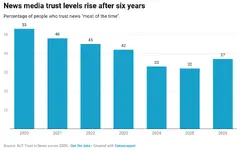
New Zealanders’ general trust in news (those who trust news “most of the time”) increased from 32% in 2025 to 37% this year and is now just below the international average of 40%.
Meanwhile, 50% of people trusted the news sources they consumed themselves, according to the survey – up from 45%.
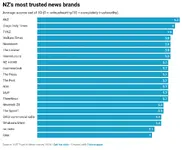
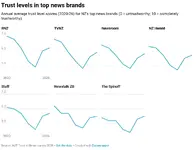
All news brands increased their own individual trust scores, with RNZ remaining ahead of the pack, followed by the
Otago Daily Times and TVNZ.
In fourth-equal spot was
The Listener, Newsroom,
Waikato Times, and interest.co.nz, followed by seven more news brands –
NZ Herald, BusinessDesk,
NBR, Stuff,
The Press,
The Post and ThreeNews.
In two years, the
Herald has leapt from fourth spot to the No 1 position as a news source after respondents were asked which news brands they had used in the previous week.
The
Herald (52%) headed off Stuff (51%), TVNZ (50%), RNZ (35%) and ThreeNews (21%). ThreeNews’ percentage has more than halved since 2024.
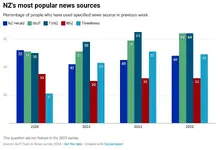
The survey showed online news sites and apps were the main news sources for 38% of New Zealanders, followed by TV (20%) and social media/video networks (19%).
The survey also showed the
Herald topping the list of subscription brands, although this fell from 22% of respondents in 2025 to 18% this year.
That drop contrasts with publicly listed
Herald owner NZME’s latest annual results.
According to the media firm, its publishing division had growth of 3% in digital subscription revenue - the division also delivered improved profitability, with 31% growth in digital publishing operating ebitda.
NZME said the number of digital subscribers grew 10% to 166,000 and total subs grew 3% year-on-year from 236,000 to 243,000.
The AUT survey said New Zealanders’ interest in the news was stable (91% of respondents said they were interested to some extent, down one percentage point), but it warned “news avoidance” had increased significantly – up five percentage points to 78%.
News avoidance is classified as people avoiding the news “to some degree (sometimes/occasionally/often)”.
Myllylahti and Treadwell said transparency, high journalistic standards and editorial independence were key factors in building trust.
“As social media and video platforms are flooded with influencers, disinformation and AI content, people are increasingly using news media for information verification. That is promising,” Myllylahti said.
Treadwell said trust levels were still “alarmingly low” and many of the accusations against journalists from earlier research – of political bias and producing opinion rather than news – remained.
But he said the latest report also showed many New Zealanders valued professional journalism, including its commitment to accuracy and other ethical standards.
The survey said many New Zealanders acknowledged “a lack of credibility in social-media content, and indicate that the rise of influencers and AI content makes them trust news media”.
Verbatim comments from the 1000-plus respondents included: “Traditional news networks and journalists will end up regaining trust, because [there] will be no way to tell whether something is AI bullshit or not.”
And: “Traditional news is run by professionals. It can be sued if it writes defamatory stories. It uses details that allow verification.”
And: “I’m pretty confident at my age I can sniff out the real thing from bogus. Plus, the sources are established sources, not an influencer.”
The survey reiterated that poor journalism was an issue of concern for almost all respondents. “Poor journalism was defined as making factual mistakes, dumbed-down stories and misleading headlines/clickbait,” said the survey.
About 60% of respondents said they were uncomfortable with news produced mainly by AI (with human oversight) – this was higher than the numbers in the US (53%) and Europe (46%).
The researchers also used the survey to fire a warning shot at news media owners and politicians.
The survey showed about 43% of New Zealanders believed interference by media owners/boards or managers with editorial decisions would decrease their trust in the media. About 27% would consider cancelling their subscriptions/payments if that happened.
Furthermore, 46% of those surveyed were extremely or very concerned about politicians publicly discrediting the news.
“New Zealanders are sending a clear message to media owners and politicians, telling them not to interfere with editorial independence or the credibility of news media in public,” Myllylahti said.
Rebuilding trust
Over several years, news organisations have been tackling the issue of trust levels in media, including - for example - clearly differentiating news articles from opinion pieces.
NZME editor-in-chief
Murray Kirkness said he was pleased the
Herald had claimed the number one position in the survey as the country’s most popular weekly news source, and with the increase in trust in all the company’s news brands.
“We are proud of the journalism we produce. Our growing overall subscriber base and the size of our audiences across digital, print and radio reflect the fact New Zealanders trust what we deliver every day,” Kirkness said.
He said the company offered “many views” across various platforms and would “continue to produce broad coverage when it comes to news, analysis and opinion”.
Kirkness said improving trust was a priority for the industry.
The Government has been hot on both TVNZ and RNZ increasing their trust levels.
RNZ chief executive
Paul Thompson said it had been a strategic focus for RNZ.
“The findings are recognition of the work we do day in and day out, living and breathing our editorial standards and training our people to provide reliable and independent news and information,” he said.
“It endorses the RNZ approach of investing in trust initiatives, both internally and through the sharing of our high-quality content with other media outlets.”
While he appreciated trust levels were increasing, there was “always more to be done”.
As AI 'slop' dominates social media feeds, news media are rebuilding public trust.

www.nzherald.co.nz