Politics πŸ—³οΈ NZ Politics

Be a huge savings on salaries and imagine if they weren't allowed to vote while incarcerated
My old man jokingly said that every politician should be worth at least $10 million to stop them from being open to corruption... or was he joking?
 
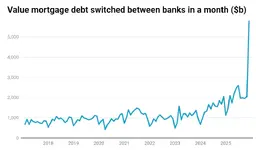
People are jumping banks searching for better interest rates and larger cashbacks in record numbers.... the monthly figure for those changing banks is around $2 billion.... in December '25, it was over $5 billion. Below is a graph from the herald.

1769671791810.webp
 
My old man jokingly said that every politician should be worth at least $10 million to stop them from being open to corruption... or was he joking?
Unfortunately Mike it is likely that it was corruption that got them to the $10m and leopards and spots..
 
Another major it outage in the health system.

This government has slashed Frontline it workers and cancelled much needed upgrades

While its true there's been cuts in IT staff, the latest issues have been caused by third party vendors. One of the major issues Health NZ has is there are too many systems in place. Removing the DHB's under the previous government was meant to change this but didn't but it did lead to a massive increase in IT staff numbers.

I think they shouldn't be cutting back any IT staff until they have a far more integrated system/s in place.

While I like the idea of having localised DHB's (which can respond better to local needs), it's caused too many "stand alone" systems to be developed.

Another thing I've noticed about IT, is how as more powerfuul software is developed, the manufacturer's of the hardware increase their capacity... meaning more power hungry software is produced. It's a never ending symbiotic relationship where the consumer ended up having to replace software/hadrware to keep up without realising they're barely scratching the surface of the capacity of what their machines/softwares needs actually are.

For goodness sake.... a modern digital watch has more computing power than the computers that sent man to the moon.
 
While its true there's been cuts in IT staff, the latest issues have been caused by third party vendors. One of the major issues Health NZ has is there are too many systems in place. Removing the DHB's under the previous government was meant to change this but didn't but it did lead to a massive increase in IT staff numbers.

I think they shouldn't be cutting back any IT staff until they have a far more integrated system/s in place.

While I like the idea of having localised DHB's (which can respond better to local needs), it's caused too many "stand alone" systems to be developed.

Another thing I've noticed about IT, is how as more powerfuul software is developed, the manufacturer's of the hardware increase their capacity... meaning more power hungry software is produced. It's a never ending symbiotic relationship where the consumer ended up having to replace software/hadrware to keep up without realising they're barely scratching the surface of the capacity of what their machines/softwares needs actually are.

For goodness sake.... a modern digital watch has more computing power than the computers that sent man to the moon.
This is largely due to our culture of deferred investment and piecemeal approach to all NZ infrastructure. We tend to have fragmented systems and patch them up until they’re effectively worn out, then scramble when they fail.
Public sector systems should talk to each other so the data Govt has is actually useful across the services people use. Treat IT like real infrastructure.
We should have a proper Govt IT division developing and adapting open-source software for public sector need and actually owning it. It’s core infrastructure and in 2026, a national security issue. This is part of a wider discussion about data sovereignty and resilience we should be having. Heavy reliance on third party developers and multinationals for critical Govt data carries real risks.
 
This is largely due to our culture of deferred investment and piecemeal approach to all NZ infrastructure. We tend to have fragmented systems and patch them up until they’re effectively worn out, then scramble when they fail.
Public sector systems should talk to each other so the data Govt has is actually useful across the services people use. Treat IT like real infrastructure.
We should have a proper Govt IT division developing and adapting open-source software for public sector need and actually owning it. It’s core infrastructure and in 2026, a national security issue. This is part of a wider discussion about data sovereignty and resilience we should be having. Heavy reliance on third party developers and multinationals for critical Govt data carries real risks.
Does the govt have the skills, scale and experience that multinationals have?

Why try to reinvest the wheel for an international scale problem locally when multinationals are doing this for multiple countries.
 
This is largely due to our culture of deferred investment and piecemeal approach to all NZ infrastructure. We tend to have fragmented systems and patch them up until they’re effectively worn out, then scramble when they fail.
Public sector systems should talk to each other so the data Govt has is actually useful across the services people use. Treat IT like real infrastructure.
We should have a proper Govt IT division developing and adapting open-source software for public sector need and actually owning it. It’s core infrastructure and in 2026, a national security issue. This is part of a wider discussion about data sovereignty and resilience we should be having. Heavy reliance on third party developers and multinationals for critical Govt data carries real risks.
Totally agree... and then there's the obsession with requiring the latest software. I read somewhere that around 90% of the tasks done by the average user of Word and Excel could have been done on the early version of MS Works that worked on Win 3.1. Imagine how many thousands or millions could have been saved by public/private organisations in NZ if they hadn't fallen into the trap of upgrading everytime MS released a "new" version of Office.
 
Does the govt have the skills, scale and experience that multinationals have?

Why try to reinvest the wheel for an international scale problem locally when multinationals are doing this for multiple countries.

Does Govt currently have the same ability/capability as multinationals in every domain? No.
But that isn’t a natural limitation. It’s the result of decades of deliberate outsourcing and capability erosion. And using that erosion as the justification to outsource even more just locks the problem in permanently. As I’ve been arguing in the other thread, capability and capacity can be rebuilt through policy and investment.

The question isn’t whether Govt should replace multinationals. It’s whether Govt should retain enough in house capability to be an intelligent client, owner, and manager of our critical systems.
Multinationals are very good at delivering products at scale. They are not accountable for long term national resilience, data sovereignty, continuity of service, or adapting systems to local law, language, and institutions. That responsibility sits with Govt.

When Govt outsources everything, it doesn’t stay efficient, it becomes dependent. The skills base dies, institutional memory disappears, and costs rise because the buyer no longer understands what it’s buying. That’s how you end up locked into third parties, unable to adapt systems, and paying premiums for what should be routine supplier interactions.
Look at IRD. The current system is far better than the grossly outdated DOS based system it replaced, but we are now reliant on multiple external providers for maintenance and upgrades, at very high ongoing cost and with real dependency risks. That’s the trade off of hollowing out in house capability.

Do we want to be a serious country with core public capability, or are we comfortable with a hollowed out public service and unhealthy dependencies on multinationals, hoping they’ll look after our national interests.
Treating Govt capability as β€œreinventing the wheel” is the same mistake as treating infrastructure maintenance as wasteful. It looks cheaper right up until it fails, and then you discover you no longer know how to fix it.
 
Last edited:
Back
Top Bottom