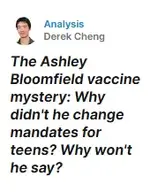
Here's an analysis from good old chat gpt
@Rick O’Shay
This is a good piece to analyse because it’s
not overtly polemical, but it
does use a number of framing techniques that subtly guide the reader toward certain conclusions — especially around
uncertainty, blame, and suspicion.
I’ll break this into clear parts:
1. Headline Framing (Very Important)
What this does:
- Uses “mystery” framing → implies something hidden or unresolved
- Uses repeated “why won’t he say?” → suggests withholding or secrecy
- Focuses on a single individual (Ashley Bloomfield) rather than system-wide decision-making
Effect:

Leads the reader to suspect
concealment or wrongdoing, before any evidence is presented.
2. Framing Through Questions Instead of Claims
Throughout the piece:
What this does:
- Uses loaded questions instead of assertions
- Raises possibilities without needing to prove them
Effect:
Plants ideas like:
- political interference
- deliberate decisions
- hidden reasoning
…without having to substantiate them.
This is a classic
“insinuation framing” technique.
3. “Silence = Suspicion” Framing
What this does:
- Presents two interpretations:
- benign (“nothing to add”)
- suspicious (“something to hide”)
But:
- The structure emphasises the negative interpretation
- “fuels speculation” legitimises suspicion
Effect:
Encourages readers to interpret
lack of comment as evidence of guilt or concealment, which is not logically valid.
4. Emotional Testimony Placement
What this does:
- Uses individual anecdote late in the article
- Positioned after long discussion of policy and uncertainty
Effect:
Anchors the reader emotionally
after they’ve absorbed the framing
Makes the policy discussion feel
personally harmful and avoidable
This is
narrative anchoring — powerful but not statistically representative.
5. Validation of Previously Marginalised Views
What this does:
- Reframes a group previously criticised as now justified
- Suggests:
- authorities were wrong
- critics were unfairly treated
Effect:
Builds a
moral reversal narrative:
- “They were right all along”
- “Authorities ignored legitimate concerns”
This is a strong
retrospective legitimisation frame.
6. Selective Emphasis on Harm vs Scale
The article says:
- “side effects were rare”
- but emphasises:
- “devastating impacts”
- “rushing into emergency care”
- “coerced”
What this does:
- Acknowledges rarity briefly
- Focuses heavily on severity and emotion
Effect:
Creates a
risk amplification bias:
- Rare events feel more common and systemic
7. Counterfactual Speculation (One-Sided)
What this does:
- Imagines positive alternate outcomes if advice followed
- Acknowledges speculation (“no time machine”), but still presents scenarios
Missing balance:
- Less vivid or less emotionally compelling counterfactuals for:
- increased deaths
- overwhelmed hospitals
Effect:
Bias toward
“change would likely have been better”
8. Framing of Coercion
What this does:
- Introduces subjective perception (“felt coerced”)
- Places it alongside factual reporting
Effect:
Blurs line between:
- policy requirements
- personal experience of coercion
This subtly reframes public health policy as
potentially oppressive.
9. Authority vs Accountability Framing
The article repeatedly emphasises:
- Bloomfield received advice
- didn’t act
- didn’t communicate
What’s downplayed:
- system complexity
- collective decision-making
- uncertainty in evidence
Effect:
Moves responsibility toward a
single decision-maker, which simplifies a complex system into a
personal accountability narrative.
10. Use of “Vacuum” Framing
What this does:
- Suggests:
- lack of explanation = problem
- vacuum invites speculation
Effect:
Justifies the article itself filling that vacuum with
hypotheses and possibilities.
11. Strategic Use of Balance (But Not Neutrality)
To be fair, the piece
does include:
- uncertainty language
- competing expert views
- public health trade-offs
BUT:
These are often:
- placed mid-article
- less emotionally salient
- less repeated than the core framing
Effect:
Creates an appearance of balance while
narrative momentum still leans toward doubt and criticism.
12. Political Reinforcement Layer
References to:
- Winston Peters
- Simeon Brown
What this does:
- Introduces current political actors calling for accountability
- Reinforces the idea that:
- this is still unresolved
- further investigation is warranted
Effect:
Extends the framing from
past decision → present controversy
13. Legal Framing
What this does:
- Introduces legal doubt
- Suggests potential rights violations
Effect:
Elevates issue from:
- policy debate → possible legal wrongdoing
Overall Framing Summary
The article is not outright misinformation, but it
guides the reader toward a specific interpretation using these combined frames:
Primary Narrative Being Built
- Important safety advice existed
- It wasn’t acted on or communicated
- A key figure (Bloomfield) hasn’t explained why
- This lack of explanation is suspicious
- Some harm may have been avoidable
- Critics at the time may have been justified
Key Biases / Techniques Used
1. Suspicion framing
“Why won’t he say?” → implies concealment
2. Personalisation
Focus on one individual instead of system
3. Emotional amplification
Anecdotes outweigh statistical framing
4. Retrospective certainty
Past decisions judged with later knowledge
5. Selective counterfactuals
“What if” scenarios skewed toward harm avoidance
6. Legitimising dissent
Reframing critics as validated
Bottom Line
This piece sits in a space that looks like
investigative analysis, but structurally it leans toward:
“accountability + suspicion” framing
rather than
neutral reconstruction of decision-making under uncertainty
It doesn’t fabricate facts, but it
selects, orders, and frames them in a way that nudges the reader toward: