Navigation
Install the app
How to install the app on iOS
Follow along with the video below to see how to install our site as a web app on your home screen.
Note: This feature may not be available in some browsers.
More options
You are using an out of date browser. It may not display this or other websites correctly.
You should upgrade or use an alternative browser.
You should upgrade or use an alternative browser.
Social Introducing NZW Ultimate Team
- Thread starter tajhay
- Start date
Other
View all 2 threadmarks
Reader mode
Reader mode
Recent threadmarks
Franchise Owners - Must Read Warriors Ultimate Team
Top one, the one involving Steve Price.
I was on my phone and the buttons were both green, one above the other.
I was on my phone and the buttons were both green, one above the other.
- Thread starter
- #383
Whilst i am testing different things in the simulated games, yes a squad of about 25 is probably the sweet spot, and ideally you should try to have depth in all positions.I was gonna come back with TMM but after seeing the injuries in these games I’m thinking some halves depth might be useful!!
- Thread starter
- #384
OK i can fix it for you. RTS for Tomkins instead to make up for your screw up?Top one, the one involving Steve Price.
I was on my phone and the buttons were both green, one above the other.
 j/k
j/kCan someone send me a trade offer. i will reject but just want to confirm a few things.
@roguei traded back so no harm. Wish all the franchises were as good as he is….OK i can fix it for you. RTS for Tomkins instead to make up for your screw up?
Can someone send me a trade offer. i will reject but just want to confirm a few things.

wizard of Tauranga
🏃
Ironman
We can still just recruit in from the draft players after the season starts?Whilst i am testing different things in the simulated games, yes a squad of about 25 is probably the sweet spot, and ideally you should try to have depth in all positions.
- Thread starter
- #387
correct., if you have squad space and salary cap available.We can still just recruit in from the draft players after the season starts?
Thats why it does not make sense it use up all 30 squad positions at this stage.
- Thread starter
- #388
Ok Fixed.I was on my phone and the buttons were both green, one above the other.
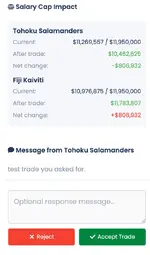
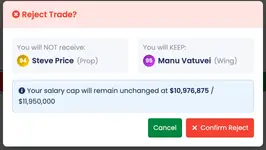
Also confirmation box added to give one more chance at reviewing the action of accept or trade and impact on salary cap.
- Thread starter
- #389
uggh did you guys reverse the trade yourselves? i reversed the reversal it seems as it seems you just just did it yourselves after asking for it to be done.If it was me happy to put a reverse now.
Reversed the 2 reversals.
Now the screen buttons are correct, and has a confirmation modal as well. So no more reversals. If you need reversals, you will need to ask the other trade party to consider reversing it but its upto them.

So how do you watch a game? Or a replay?
- Thread starter
- #391
Ill explain soon.So how do you watch a game? Or a replay?
- Thread starter
- #392
Ill do that now actually.Ill explain soon.
In the dashboard when games are played or available to be watched, it will have a 'Watch Game' icon. Clicking it will take you to watch your game. The scores are not revealed here for that reason if you are involved in that game.
Also if you want to watch other teams games, you can just click the score i.e. 24 - 30 to watch the Knights V Hawks Game.
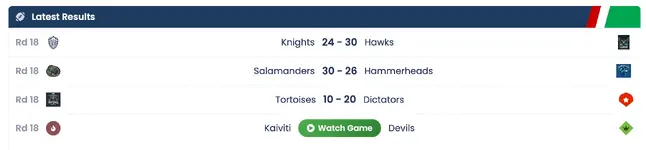
Right now those links are linked to simulated games so they wont work. Big post coming shortly.
Franchise Owners - Must Read
- Thread starter
- #393
@Ultimate Team Franchisees, I would recommend you bookmark this page. I anticipate you may be looking through this guide throughout the season.
Ultimate Team Simulation Engine — Franchise Owner Guide
Everything you need to know about how matches are simulated, what you can
control, and how to build a winning squad.
TABLE OF CONTENTS
1. GAME PLAN OPTIONS (WHAT YOU CONTROL)
Your game plan is your biggest lever. These are the settings you can configure before
each match.
Attack
Defence
Kicking
Interchange
Game Management
Key Players
2. INTERCHANGE & ROTATION SYSTEM
Each team gets a maximum of 8 interchanges per match.
How Tactical Interchanges Work
Who Gets Subbed Off?
The engine follows NRL coaching logic:
Rotation Priority
Different positions are rotated with different urgency, matching real NRL patterns:
Interchange Plans
NRL-Style Rotation
Players subbed off go to the bench, not out of the game. They can be brought back
on later — consuming another interchange. This allows the classic prop rotation pattern:
Prop A starts → subbed around 25 min → rests on bench → returns around 55 min for the run
home.
Bench players recover fatigue while resting on the sideline.
3. FATIGUE & PLAYER CONDITION
Every player starts the match fully fresh and gradually tires as the game progresses.
Position-Specific Fatigue
Different positions tire at different rates, matching real NRL workloads:
What Accelerates Fatigue?
What Does Fatigue Do?
Player Attributes That Affect Fatigue
4. BENCH BUILDING STRATEGY
Your bench composition matters. Here's the key decision:
The Classic NRL Bench: 3 Forwards + 1 Utility Back
4 Forwards Bench
All 4 bench players rotate through. Maximum forward freshness. But if a back goes down
injured, you're covering with a forward out of position — effectiveness drops
significantly.
Secondary Positions Matter
When injuries or HIAs force positional changes, the engine looks at primary and
secondary positions to find the best fit. A bench Lock with Second-row secondary
is more versatile than one with no secondaries. Players with useful secondary positions
make your squad more resilient.
5. HIA & INJURY REPLACEMENT
HIA (Head Injury Assessment)
Injuries
How Replacements Are Found
When a player goes down, the engine runs an intelligent replacement search:
Example: Your Fullback cops an HIA. No bench Fullback exists, but your Wing has
Fullback as a secondary. The Wing slides to Fullback, and your bench Centre fills the
Wing spot. Two moves, but the best possible coverage.
6. POSITION CHANGES & RESHUFFLING
Out-of-Position Penalties
Players forced to play outside their natural position suffer reduced effectiveness:
The penalty is lighter on defence — a player out of position can still make tackles, but
their attacking contribution drops noticeably.
How Reshuffles Work
When a vacancy opens up (injury, HIA, send-off), the engine scores every possible
player-to-position fit. It always prefers primary position matches over secondary, and
secondary over no match. It will cascade up to 3 moves deep to find the best overall
coverage.
This means having players with useful secondary positions on your roster is genuine
squad-building strategy.
Out-of-Position Fatigue
Players playing out of position also tire faster, compounding the effectiveness penalty
over time.
7. ATTACK MECHANICS & EDGE CHAINS
Edge Chain Attacks
The engine simulates structured NRL-style edge attacks. In the middle of the set, your
team can launch a chain attack down one edge.
Left edge chain: Five-eighth (6) → Left Second-row (11) → Left Centre (4) → Left
Wing (5)
Right edge chain: Halfback (7) → Right Second-row (12) → Right Centre (3) → Right
Wing (2)
Each completed link in the chain builds danger. The longer the chain survives without
being broken, the more likely it results in a try or line break.
Special Plays Within Chains
These trigger based on player attributes — higher-rated players unlock more options:
Try-Saving Cover Defence
When a chain attack is building dangerously, the opposition's cover defence can read the
play and shut it down. Good defensive teams can nullify even the best-constructed attack.
Defensive Line Speed
Your middle defenders' (Hooker, Props, Second-rowers, Lock) combined speed, game sense,
and endurance determine your defensive line speed. A fast line forces more errors and
reduces line breaks. A slow line gives attackers more time and space. Line speed
naturally drops in the second half as forwards tire.
Marker Defence
Your Hooker and Lock set the ruck quality at every tackle. Good markers with strong
tackling and game sense shut down early-tackle opportunities and force errors. Poor
markers give away easy play-the-ball momentum.
8. DEFENCE MECHANICS
Defence Intensity Effects
Goal-Line Defence
When the opposition is camped on your try line:
Spine Quality
Your spine (Fullback, Hooker, Halves) drives your overall attack quality. A quality spine
lifts the whole team's attacking output. A weak spine drags it down.
9. KICKING & KICKOFF STRATEGIES
Kicking Strategy
Kickoff Strategy
Goal Kicking
Your designated goal kicker's kicking attribute determines conversion and penalty goal
accuracy. Your designated field goal kicker's attributes determine drop goal success
rate.
10. BACKFIRE & COUNTER-PLAY SYSTEMS
Every tactical option has a trade-off. Overuse any strategy and the opposition adapts.
Edge Preference Backfire
If you set edge preference to Left or Right and keep attacking the same edge repeatedly,
the defence reads the pattern. They shift help defenders to that side and your attacks
become less effective. Mix it up or pay the price.
Attack Target Backfire
Repeatedly targeting the same defender triggers the opposition's defensive coach to shift
help to that channel. Your attack advantage at that position shrinks the more you go
there.
Defence Target Counter-Play
When you run big forwards at a specific opposition player, that player can read the slow
forward coming and counter. The halves or hooker might fire a quick pass wide to exploit
the space the forward left, or the centres/wingers read the gap and run through it. Your
forward gains minimal metres and the targeted player turns it into an advantage.
Long Kick Downside
Long kicks give the defence extra time to set up their defensive line. This means more
penalties and fewer line breaks on the return set.
Target Weakness Kickoff Adaptation
After repeated use, the opposition repositions their weak aerial player. The advantage
diminishes each time you use it.
Interchange Plan Trade-offs
11. DISCIPLINE — SIN BIN & SEND OFF
Sin Bin (Yellow Card)
Send Off (Red Card)
12. MOMENTUM & FORM
In-Match Momentum
Momentum builds through successful plays — tries, line breaks, forcing errors, winning
penalties. A team on a roll gets a genuine performance boost: more line breaks, fewer
errors. The team on the back foot cops the opposite.
Player Form
Form carries across matches. Players in hot form perform noticeably better; players in
cold form underperform.
Morale
Morale is affected by wins, losses, and individual performance. Low morale leads to more
errors. High morale reduces them. Winning breeds confidence, losing erodes it.
Chemistry
Players who share connections — same era, natural positional partnerships, historical
bonds — can trigger chemistry moments during the game. These provide small performance
lifts and add narrative flavour to the commentary.
13. PLAYER ATTRIBUTES & WHAT THEY DO
Offensive Attributes
Defensive Attributes
Conditioning Attributes
Leadership
14. POST-MATCH CONDITION CHANGES
After each game, player conditions are updated:
Fitness
Morale
Form
Key Takeaways for Franchise Owners
Ultimate Team Simulation Engine — Franchise Owner Guide
Everything you need to know about how matches are simulated, what you can
control, and how to build a winning squad.
TABLE OF CONTENTS
- Game Plan Options (What You Control)
- Interchange & Rotation System
- Fatigue & Player Condition
- Bench Building Strategy
- HIA & Injury Replacement
- Position Changes & Reshuffling
- Attack Mechanics & Edge Chains
- Defence Mechanics
- Kicking & Kickoff Strategies
- Backfire & Counter-Play Systems
- Discipline — Sin Bin & Send Off
- Momentum & Form
- Player Attributes & What They Do
- Post-Match Condition Changes
1. GAME PLAN OPTIONS (WHAT YOU CONTROL)
Your game plan is your biggest lever. These are the settings you can configure before
each match.
Attack
- Attack Style — Running, Kicking, or Balanced. Running
favours forward carries and line breaks. Kicking focuses on field position through the
boot. Balanced mixes both.
- Second Half Attack — Running, Kicking, Balanced, or
Same (keep 1st half approach). Allows you to change strategy at halftime.
- Attack Target Position — Nominate a specific opposition jersey number (1-17) to
target with your attack. Your team will channel more ball movement toward that defender.
Useful for exploiting a weak defender — but be warned, overuse triggers a backfire (see
Section 10).
- Edge Preference — Left, Right, or Balanced. Directs edge
attacks down your preferred side. Again, predictability triggers a backfire.
Defence
- Defence Intensity — Aggressive, Standard, or Conservative.
Aggressive pushes your line faster (more pressure, forces errors) but risks more
penalties. Conservative is safer but gives attackers more space.
- Second Half Defence — Aggressive, Standard, Conservative,
or Same. Change intensity at halftime.
- Defence Target Position — Nominate an opposition jersey number to run your big
forwards at. Useful for targeting a small playmaker. But the targeted player can read it
and counter-play (see Section 10).
Kicking
- Kicking Strategy — Long, Short, or Tactical. Long kicking
gains territory but gives the defence time to set. Short kicks create quicker attacking
opportunities. Tactical is a balanced mix.
- Kickoff Strategy — Deep, Short, or Target Weakness. Deep
is standard. Short puts the ball closer. Target Weakness kicks at the opposition's
weakest aerial player in the back three — but coaches adapt after repeated use.
Interchange
- Interchange Plan — Early, Balanced, or Save Second Half.
Detailed breakdown in Section 2.
Game Management
- Game Management — Stick to Plan, Adaptive, or Closer.
Controls how your team adjusts to match flow.
Key Players
- Captain — Provides leadership bonuses in pressure moments (late game, attacking
zone). Boosts morale and can lift teammates' performance.
- Goal Kicker — Designated conversion and penalty kicker. Their kicking attribute
determines accuracy.
- Field Goal Kicker — Designated drop goal kicker. Rare opportunities but high
value.
2. INTERCHANGE & ROTATION SYSTEM
Each team gets a maximum of 8 interchanges per match.
How Tactical Interchanges Work
- Only forward bench players (Prop, Hooker, Lock, Second-row) are used for
tactical rotations
- Bench backs (Fullback, Wing, Centre, Five-eighth, Halfback) are never
tactically subbed — they are injury/HIA cover only (see Section 5)
- The engine selects the freshest available forward on the bench, with a strong
preference for bench players who haven't had a stint yet — ensuring all forward bench
players get game time
Who Gets Subbed Off?
The engine follows NRL coaching logic:
- Positional match first — If a bench Prop is coming on, the engine looks for the
starting Prop who has been on field the longest
- Override if another forward is gassed — If any other forward has been on field
significantly longer than the positional match, they get subbed off instead (a real coach
would prioritise the most fatigued player)
- Fallback — If no positional match exists, the longest-stint forward is subbed
off
Rotation Priority
Different positions are rotated with different urgency, matching real NRL patterns:
- Props (8, 10) — Highest rotation priority. Props tire the fastest and are
flagged for interchange after roughly 25 minutes on field. They typically play around
50-57 minutes total across multiple stints.
- Lock (13) — Moderate priority. Flagged for rotation after longer stints than
props. Locks typically play around 60-65 minutes.
- Second-rowers (11, 12) — Protected from early rotation. They play one
long stint and won't be subbed off until well into the second half. Second-rowers
typically play 68-75 minutes, similar to real NRL.
- Hooker (9) — Only rotated if you carry a bench Hooker. If no bench Hooker
exists, the starting Hooker plays the full 80 minutes.
- Backs (1-7) — Never tactically rotated. Play the full 80 minutes.
Interchange Plans
- Early — Subs start earlier in the match with more frequent rotations. Keeps
forwards fresher throughout the game. Trade-off: Bench players who already played
in the 1st half fatigue significantly faster in the 2nd half — they've already burned
energy.
- Balanced — Standard rotation timing and frequency. No special bonuses or
penalties.
- Save Second Half — Subs delayed until later in the first half. Very
conservative early rotations. Trade-off: Starting forwards bear extra fatigue in
the 1st half with no bench relief. Benefit: In the 2nd half, rotation ramps up
aggressively and bench players enter with a freshness bonus for their first 10 minutes on
field.
NRL-Style Rotation
Players subbed off go to the bench, not out of the game. They can be brought back
on later — consuming another interchange. This allows the classic prop rotation pattern:
Prop A starts → subbed around 25 min → rests on bench → returns around 55 min for the run
home.
Bench players recover fatigue while resting on the sideline.
3. FATIGUE & PLAYER CONDITION
Every player starts the match fully fresh and gradually tires as the game progresses.
Position-Specific Fatigue
Different positions tire at different rates, matching real NRL workloads:
- Props — Tire the fastest of any position. This is why they need rotation.
- Lock — Tires moderately fast. Sometimes rotated.
- Hooker — Moderate fatigue. High tackle count but decent staying power.
- Second-row — Tire slowly. Designed for one long stint without rotation.
- Halves — Barely fatigue. Play the full 80 comfortably.
- Backs (Fullback, Wings, Centres) — Slowest fatigue of any position. Play the
full 80 with no issues.
What Accelerates Fatigue?
- Early-game intensity — The first 15 minutes: everyone tires faster as both
packs fire up
- Heavy workload — Players making lots of carries and tackles tire faster than
those who aren't involved. Carries are more taxing than tackles.
- Repeat set defence — Defending 2, 3, 4 consecutive sets is brutal. Forwards cop
it the hardest.
- Late game — After 55 minutes, fatigue accelerates for everyone
- Interchange plan — The Save Second Half plan forces starters to carry extra
load early on
What Does Fatigue Do?
- Tired players make more errors
- Reduced line break and try-scoring ability
- Defensive line speed drops as the pack tires
- This is why interchange management matters — keeping forwards fresh is the difference
between holding out a late attack and leaking soft tries
Player Attributes That Affect Fatigue
- Fitness — The primary factor. Higher fitness = slower fatigue rate.
- Endurance — Complements fitness for staying power.
- A player with elite fitness and endurance will last far longer on the field than one
with poor conditioning — they could fatigue up to three times slower.
4. BENCH BUILDING STRATEGY
Your bench composition matters. Here's the key decision:
The Classic NRL Bench: 3 Forwards + 1 Utility Back
- 3 forward bench players handle all your tactical rotations. Typically 2 Props +
1 Lock/Second-row, or 2 Props + 1 Hooker.
- 1 utility back sits on the bench as injury/HIA insurance. If no backs get hurt,
this player gets zero minutes. But if your fullback cops an HIA, having a Centre
with Fullback secondary on the bench means a seamless replacement instead of playing a
forward at fullback.
4 Forwards Bench
All 4 bench players rotate through. Maximum forward freshness. But if a back goes down
injured, you're covering with a forward out of position — effectiveness drops
significantly.
Secondary Positions Matter
When injuries or HIAs force positional changes, the engine looks at primary and
secondary positions to find the best fit. A bench Lock with Second-row secondary
is more versatile than one with no secondaries. Players with useful secondary positions
make your squad more resilient.
5. HIA & INJURY REPLACEMENT
HIA (Head Injury Assessment)
- HIAs happen randomly during the match — roughly one every couple of games on average
- The injured player is removed from the field and assessed for 10 minutes
- A free interchange is made — does NOT count toward your 8-interchange limit
- Most of the time the player passes the HIA and returns to the field. The positional
reshuffle is reversed and everything goes back to normal.
- Sometimes the player fails the HIA and is ruled out for the rest of the game. They
also cop a 1-round injury.
Injuries
- Injuries can happen at any point during the match
- Injured players are permanently removed
- Uses a regular interchange (counts toward the 8 limit)
- Severity ranges from minor to season-ending
How Replacements Are Found
When a player goes down, the engine runs an intelligent replacement search:
- Direct bench match — Is there a bench player whose primary position matches the
vacant spot? If yes, straight swap.
- Cascade reshuffle — If no direct match, the engine looks for an on-field player
who can slide into the vacant position (via their secondary position), then fills THEIR
vacated spot from the bench. Up to 3 levels of cascade.
- Best available — If no positional match exists at all, the closest bench player
fills the gap.
Example: Your Fullback cops an HIA. No bench Fullback exists, but your Wing has
Fullback as a secondary. The Wing slides to Fullback, and your bench Centre fills the
Wing spot. Two moves, but the best possible coverage.
6. POSITION CHANGES & RESHUFFLING
Out-of-Position Penalties
Players forced to play outside their natural position suffer reduced effectiveness:
- Primary position = Full effectiveness
- Secondary position = Reduced effectiveness (varies by how close the position
is)
- No match at all = Significant effectiveness drop (e.g. a Prop at Fullback)
The penalty is lighter on defence — a player out of position can still make tackles, but
their attacking contribution drops noticeably.
How Reshuffles Work
When a vacancy opens up (injury, HIA, send-off), the engine scores every possible
player-to-position fit. It always prefers primary position matches over secondary, and
secondary over no match. It will cascade up to 3 moves deep to find the best overall
coverage.
This means having players with useful secondary positions on your roster is genuine
squad-building strategy.
Out-of-Position Fatigue
Players playing out of position also tire faster, compounding the effectiveness penalty
over time.
7. ATTACK MECHANICS & EDGE CHAINS
Edge Chain Attacks
The engine simulates structured NRL-style edge attacks. In the middle of the set, your
team can launch a chain attack down one edge.
Left edge chain: Five-eighth (6) → Left Second-row (11) → Left Centre (4) → Left
Wing (5)
Right edge chain: Halfback (7) → Right Second-row (12) → Right Centre (3) → Right
Wing (2)
Each completed link in the chain builds danger. The longer the chain survives without
being broken, the more likely it results in a try or line break.
Special Plays Within Chains
These trigger based on player attributes — higher-rated players unlock more options:
- Cutout Ball — Half skips the second-rower and passes directly to the centre.
Requires strong passing skills.
- Inside Ball — Second-rower takes a short ball and crashes through. Requires
good agility.
- Fullback Insert — Fullback joins the line as an extra man, creating an overlap.
One of the most dangerous plays.
- Switch Play — Half passes back to the other half, switching the point of
attack. Requires good game sense.
- Double Pump — Half fakes the pass, holds, then delivers on second movement.
Requires elite game sense and passing.
- Dummy and Go — Second-rower shapes to pass but takes it himself.
- Wrap-Around — Half wraps behind the second-rower to receive the ball on the
burst.
- Blind-Side Attack — Halfback spots the defence loaded on the open side and
creates a quick 2-on-1 the other way.
- Kick-Pass — Grubber into the in-goal for the winger. Only happens close to the
try line.
- Forward Combination — Pre-chain middle play to soften the defence before going
wide.
- Positional Roaming — Players swap positions to create mismatches in the
defensive line.
- Scrum Set-Piece Play — Structured play straight from scrum ball.
Try-Saving Cover Defence
When a chain attack is building dangerously, the opposition's cover defence can read the
play and shut it down. Good defensive teams can nullify even the best-constructed attack.
Defensive Line Speed
Your middle defenders' (Hooker, Props, Second-rowers, Lock) combined speed, game sense,
and endurance determine your defensive line speed. A fast line forces more errors and
reduces line breaks. A slow line gives attackers more time and space. Line speed
naturally drops in the second half as forwards tire.
Marker Defence
Your Hooker and Lock set the ruck quality at every tackle. Good markers with strong
tackling and game sense shut down early-tackle opportunities and force errors. Poor
markers give away easy play-the-ball momentum.
8. DEFENCE MECHANICS
Defence Intensity Effects
- Aggressive — Faster line speed, more error forcing, but higher penalty rate
- Standard — Balanced approach
- Conservative — Lower penalty risk, but less pressure on the ball carrier
Goal-Line Defence
When the opposition is camped on your try line:
- Your team digs in and defends desperately — line breaks are harder to come by
- But after several repeat sets on the goal line, the defence starts to crack. Fatigue
compounds and gaps open up.
- The longer you're stuck defending on your own line, the more likely you are to concede
Spine Quality
Your spine (Fullback, Hooker, Halves) drives your overall attack quality. A quality spine
lifts the whole team's attacking output. A weak spine drags it down.
9. KICKING & KICKOFF STRATEGIES
Kicking Strategy
- Long — Big kicks for territory. Drawback: gives the defence time to set up
their line for the return set.
- Short — Quicker attacking ball. Better chance of catching the defence short but
less territory gained.
- Tactical — Mix of both approaches.
Kickoff Strategy
- Deep — Standard kickoff. Receiving team starts deep in their own half.
- Short — Receiving team gets the ball closer to midfield.
- Target Weakness — Kicks at the opposition's weakest aerial player in the back
three (Fullback, Wings). More likely to force errors on reception. But after repeated
use, the opposition adapts and repositions their weak player to minimise the damage.
Goal Kicking
Your designated goal kicker's kicking attribute determines conversion and penalty goal
accuracy. Your designated field goal kicker's attributes determine drop goal success
rate.
10. BACKFIRE & COUNTER-PLAY SYSTEMS
Every tactical option has a trade-off. Overuse any strategy and the opposition adapts.
Edge Preference Backfire
If you set edge preference to Left or Right and keep attacking the same edge repeatedly,
the defence reads the pattern. They shift help defenders to that side and your attacks
become less effective. Mix it up or pay the price.
Attack Target Backfire
Repeatedly targeting the same defender triggers the opposition's defensive coach to shift
help to that channel. Your attack advantage at that position shrinks the more you go
there.
Defence Target Counter-Play
When you run big forwards at a specific opposition player, that player can read the slow
forward coming and counter. The halves or hooker might fire a quick pass wide to exploit
the space the forward left, or the centres/wingers read the gap and run through it. Your
forward gains minimal metres and the targeted player turns it into an advantage.
Long Kick Downside
Long kicks give the defence extra time to set up their defensive line. This means more
penalties and fewer line breaks on the return set.
Target Weakness Kickoff Adaptation
After repeated use, the opposition repositions their weak aerial player. The advantage
diminishes each time you use it.
Interchange Plan Trade-offs
- Early plan — Bench players who already played in the 1st half tire
significantly faster in the 2nd half
- Save Second Half plan — Starting forwards bear extra fatigue in the 1st half
with no rotation relief
11. DISCIPLINE — SIN BIN & SEND OFF
Sin Bin (Yellow Card)
- Can be triggered by repeated penalties or foul play near the try line
- Player sits in the sin bin for 10 minutes
- Team defends with 12 players during this time
- The attacking team gains a significant advantage while the opposition is a man short —
more line breaks, fewer errors, higher try-scoring rate
- Player automatically returns after 10 minutes
Send Off (Red Card)
- Very rare — only for egregious foul play
- Player permanently removed from the game
- Team plays with 12 for the remainder
12. MOMENTUM & FORM
In-Match Momentum
Momentum builds through successful plays — tries, line breaks, forcing errors, winning
penalties. A team on a roll gets a genuine performance boost: more line breaks, fewer
errors. The team on the back foot cops the opposite.
Player Form
Form carries across matches. Players in hot form perform noticeably better; players in
cold form underperform.
- Hot form — Significant try/line break bonus
- Cold form — Noticeable penalty to output
- Form trends toward each player's performance level after every game — consistently
strong performances build form, poor games drop it
Morale
Morale is affected by wins, losses, and individual performance. Low morale leads to more
errors. High morale reduces them. Winning breeds confidence, losing erodes it.
Chemistry
Players who share connections — same era, natural positional partnerships, historical
bonds — can trigger chemistry moments during the game. These provide small performance
lifts and add narrative flavour to the commentary.
13. PLAYER ATTRIBUTES & WHAT THEY DO
Offensive Attributes
- Speed — Line break ability. Critical for outside backs. Works together with
agility.
- Agility — Complements speed for line breaks. Also enables Inside Ball plays in
chain attacks.
- Power — Crash run effectiveness. Essential for props and second-rowers to punch
through the defensive line.
- Passing — Chain pass success rate. Elite passing unlocks Cutout Ball plays.
Poor passing increases intercept risk.
- General Kicking — Goal kick accuracy for conversions and penalty goals.
- Field Goals — Drop goal success rate.
Defensive Attributes
- Tackling — Primary defensive stat. Determines tackle completion and marker
quality at the ruck.
- Game Sense — Defensive reading, marker quality (works with tackling), and
enables special plays like Switch Play and Double Pump.
- Aerial — High ball management. Critical for your back three (Fullback, Wings)
in kickoff reception and under the high ball.
Conditioning Attributes
- Fitness — The primary factor in how quickly a player tires. Higher fitness =
slower fatigue.
- Endurance — Complements fitness for staying power.
- Consistency — Reduces performance variance from set to set. High consistency =
reliable output. Low consistency = more unpredictable — brilliant one set, quiet the
next.
Leadership
- Leadership — Captains with high leadership provide bigger bonuses in pressure
moments (late game, close scores, attacking the try line). Also influences team morale.
14. POST-MATCH CONDITION CHANGES
After each game, player conditions are updated:
Fitness
- Starters lose a significant chunk of fitness (recovery takes 1-2 rest rounds)
- Bench players lose less fitness (shorter stints)
- Non-playing roster members recover fitness while resting
Morale
- Wins boost morale, losses drop it
- Individual standout performances provide a morale bonus on top
- Poor individual performances drop morale further
Form
- Form trends toward each player's latest performance level
- Top performers in each game get a form boost, bottom performers cop a form hit
- Consistently strong games build hot form; consistently poor games create cold form
Key Takeaways for Franchise Owners
- Build your bench wisely — 3 forwards for rotation + 1 utility back for
insurance is the optimal NRL bench. Secondary positions on your bench players add genuine
versatility.
- Don't be predictable — Every aggressive tactic has a backfire. Mix up your edge
attacks, rotate your targets, and vary your kickoff strategy.
- Fitness and endurance matter — Props with poor fitness will gas out faster and
need earlier rotation, burning interchanges. Fit forwards mean fewer subs needed.
- Your spine wins or loses games — Fullback, Hooker, and Halves drive your attack
quality. Invest in their passing, game sense, and kicking.
- Interchange plan should match your squad — If your bench forwards are elite,
Save Second Half can be devastating. If your starters are the strength, Early or Balanced
keeps them fresher.
- Captain choice matters — High leadership captains provide real bonuses in
clutch moments.
- Secondary positions are squad depth — A Centre with Fullback secondary on the
bench is far more valuable than one with no secondaries when an HIA hits.
Last edited:
On the team selection page can you add left and right next to the relevant positions? Ie left centre, left wing, left second row and same for right?
- Thread starter
- #395
Yeah sure. i can add that tomorrow.On the team selection page can you add left and right next to the relevant positions? Ie left centre, left wing, left second row and same for right?
Just note, the above is a very simplistic overview on what you do control. It does not mean that a halfback (7) will pass to second row(12) to center (3) to winger (2) on all occassions.
A fullback can chime into the line. Halfback to Second row and there could be a switch back to left etc. Its more to indicate that there are positional chains in play and there is positional awareness. so who you put next to does make a difference, in attack and in defence. You can Potentially have Ruck -> Hooker -> Halfback -> Secondrow -> Back Inside to Fullback -> Back to Center on right edge -> Offload to second rower on the inside for the try etc. At all moments in the chain, the offensive line scans the options (better game sense, the better the decisions), and to target, islotate defenders etc.
One probable tip i can give you all is to not be predictable. Teams can guage what you do and how you play. So before your game they can utilise tactics to potentially offset it (could be good, or bad if it is countered). Also ingame, coaches do make adjustments to offset it to plug gaps/change strategy via messages sent down to the players via the trainer etc.
The thought behind your strategy should always be, 'what would an NRL coach do'.
and how would he offset the lethal running game of John Simon.
Last edited:
wizard of Tauranga
🏃
Ironman
A bench hooker is lower priority than a back?@Ultimate Team[/UTTEAM] Franchisees, I would recommend you bookmark this page. I anticipate you may be looking through this guide throughout the season.
Ultimate Team Simulation Engine — Franchise Owner Guide
Everything you need to know about how matches are simulated, what you can
control, and how to build a winning squad.
TABLE OF CONTENTS
- Game Plan Options (What You Control)
- Interchange & Rotation System
- Fatigue & Player Condition
- Bench Building Strategy
- HIA & Injury Replacement
- Position Changes & Reshuffling
- Attack Mechanics & Edge Chains
- Defence Mechanics
- Kicking & Kickoff Strategies
- Backfire & Counter-Play Systems
- Discipline — Sin Bin & Send Off
- Momentum & Form
- Player Attributes & What They Do
- Post-Match Condition Changes
1. GAME PLAN OPTIONS (WHAT YOU CONTROL)
Your game plan is your biggest lever. These are the settings you can configure before
each match.
Attack
- Attack Style — Running, Kicking, or Balanced. Running
favours forward carries and line breaks. Kicking focuses on field position through the
boot. Balanced mixes both.- Second Half Attack — Running, Kicking, Balanced, or
Same (keep 1st half approach). Allows you to change strategy at halftime.- Attack Target Position — Nominate a specific opposition jersey number (1-17) to
target with your attack. Your team will channel more ball movement toward that defender.
Useful for exploiting a weak defender — but be warned, overuse triggers a backfire (see
Section 10).- Edge Preference — Left, Right, or Balanced. Directs edge
attacks down your preferred side. Again, predictability triggers a backfire.
Defence
- Defence Intensity — Aggressive, Standard, or Conservative.
Aggressive pushes your line faster (more pressure, forces errors) but risks more
penalties. Conservative is safer but gives attackers more space.- Second Half Defence — Aggressive, Standard, Conservative,
or Same. Change intensity at halftime.- Defence Target Position — Nominate an opposition jersey number to run your big
forwards at. Useful for targeting a small playmaker. But the targeted player can read it
and counter-play (see Section 10).
Kicking
- Kicking Strategy — Long, Short, or Tactical. Long kicking
gains territory but gives the defence time to set. Short kicks create quicker attacking
opportunities. Tactical is a balanced mix.- Kickoff Strategy — Deep, Short, or Target Weakness. Deep
is standard. Short puts the ball closer. Target Weakness kicks at the opposition's
weakest aerial player in the back three — but coaches adapt after repeated use.
Interchange
- Interchange Plan — Early, Balanced, or Save Second Half.
Detailed breakdown in Section 2.
Game Management
- Game Management — Stick to Plan, Adaptive, or Closer.
Controls how your team adjusts to match flow.
Key Players
- Captain — Provides leadership bonuses in pressure moments (late game, attacking
zone). Boosts morale and can lift teammates' performance.- Goal Kicker — Designated conversion and penalty kicker. Their kicking attribute
determines accuracy.- Field Goal Kicker — Designated drop goal kicker. Rare opportunities but high
value.
2. INTERCHANGE & ROTATION SYSTEM
Each team gets a maximum of 8 interchanges per match.
How Tactical Interchanges Work
- Only forward bench players (Prop, Hooker, Lock, Second-row) are used for
tactical rotations- Bench backs (Fullback, Wing, Centre, Five-eighth, Halfback) are never
tactically subbed — they are injury/HIA cover only (see Section 5)- The engine selects the freshest available forward on the bench, with a strong
preference for bench players who haven't had a stint yet — ensuring all forward bench
players get game time
Who Gets Subbed Off?
The engine follows NRL coaching logic:
- Positional match first — If a bench Prop is coming on, the engine looks for the
starting Prop who has been on field the longest- Override if another forward is gassed — If any other forward has been on field
significantly longer than the positional match, they get subbed off instead (a real coach
would prioritise the most fatigued player)- Fallback — If no positional match exists, the longest-stint forward is subbed
off
Rotation Priority
Different positions are rotated with different urgency, matching real NRL patterns:
- Props (8, 10) — Highest rotation priority. Props tire the fastest and are
flagged for interchange after roughly 25 minutes on field. They typically play around
50-57 minutes total across multiple stints.- Lock (13) — Moderate priority. Flagged for rotation after longer stints than
props. Locks typically play around 60-65 minutes.- Second-rowers (11, 12) — Protected from early rotation. They play one
long stint and won't be subbed off until well into the second half. Second-rowers
typically play 68-75 minutes, similar to real NRL.- Hooker (9) — Only rotated if you carry a bench Hooker. If no bench Hooker
exists, the starting Hooker plays the full 80 minutes.- Backs (1-7) — Never tactically rotated. Play the full 80 minutes.
Interchange Plans
- Early — Subs start earlier in the match with more frequent rotations. Keeps
forwards fresher throughout the game. Trade-off: Bench players who already played
in the 1st half fatigue significantly faster in the 2nd half — they've already burned
energy.- Balanced — Standard rotation timing and frequency. No special bonuses or
penalties.- Save Second Half — Subs delayed until later in the first half. Very
conservative early rotations. Trade-off: Starting forwards bear extra fatigue in
the 1st half with no bench relief. Benefit: In the 2nd half, rotation ramps up
aggressively and bench players enter with a freshness bonus for their first 10 minutes on
field.
NRL-Style Rotation
Players subbed off go to the bench, not out of the game. They can be brought back
on later — consuming another interchange. This allows the classic prop rotation pattern:
Prop A starts → subbed around 25 min → rests on bench → returns around 55 min for the run
home.
Bench players recover fatigue while resting on the sideline.
3. FATIGUE & PLAYER CONDITION
Every player starts the match fully fresh and gradually tires as the game progresses.
Position-Specific Fatigue
Different positions tire at different rates, matching real NRL workloads:
- Props — Tire the fastest of any position. This is why they need rotation.
- Lock — Tires moderately fast. Sometimes rotated.
- Hooker — Moderate fatigue. High tackle count but decent staying power.
- Second-row — Tire slowly. Designed for one long stint without rotation.
- Halves — Barely fatigue. Play the full 80 comfortably.
- Backs (Fullback, Wings, Centres) — Slowest fatigue of any position. Play the
full 80 with no issues.
What Accelerates Fatigue?
- Early-game intensity — The first 15 minutes: everyone tires faster as both
packs fire up- Heavy workload — Players making lots of carries and tackles tire faster than
those who aren't involved. Carries are more taxing than tackles.- Repeat set defence — Defending 2, 3, 4 consecutive sets is brutal. Forwards cop
it the hardest.- Late game — After 55 minutes, fatigue accelerates for everyone
- Interchange plan — The Save Second Half plan forces starters to carry extra
load early on
What Does Fatigue Do?
- Tired players make more errors
- Reduced line break and try-scoring ability
- Defensive line speed drops as the pack tires
- This is why interchange management matters — keeping forwards fresh is the difference
between holding out a late attack and leaking soft tries
Player Attributes That Affect Fatigue
- Fitness — The primary factor. Higher fitness = slower fatigue rate.
- Endurance — Complements fitness for staying power.
- A player with elite fitness and endurance will last far longer on the field than one
with poor conditioning — they could fatigue up to three times slower.
4. BENCH BUILDING STRATEGY
Your bench composition matters. Here's the key decision:
The Classic NRL Bench: 3 Forwards + 1 Utility Back
- 3 forward bench players handle all your tactical rotations. Typically 2 Props +
1 Lock/Second-row, or 2 Props + 1 Hooker.- 1 utility back sits on the bench as injury/HIA insurance. If no backs get hurt,
this player gets zero minutes. But if your fullback cops an HIA, having a Centre
with Fullback secondary on the bench means a seamless replacement instead of playing a
forward at fullback.
4 Forwards Bench
All 4 bench players rotate through. Maximum forward freshness. But if a back goes down
injured, you're covering with a forward out of position — effectiveness drops
significantly.
Secondary Positions Matter
When injuries or HIAs force positional changes, the engine looks at primary and
secondary positions to find the best fit. A bench Lock with Second-row secondary
is more versatile than one with no secondaries. Players with useful secondary positions
make your squad more resilient.
5. HIA & INJURY REPLACEMENT
HIA (Head Injury Assessment)
- HIAs happen randomly during the match — roughly one every couple of games on average
- The injured player is removed from the field and assessed for 10 minutes
- A free interchange is made — does NOT count toward your 8-interchange limit
- Most of the time the player passes the HIA and returns to the field. The positional
reshuffle is reversed and everything goes back to normal.- Sometimes the player fails the HIA and is ruled out for the rest of the game. They
also cop a 1-round injury.
Injuries
- Injuries can happen at any point during the match
- Injured players are permanently removed
- Uses a regular interchange (counts toward the 8 limit)
- Severity ranges from minor to season-ending
How Replacements Are Found
When a player goes down, the engine runs an intelligent replacement search:
- Direct bench match — Is there a bench player whose primary position matches the
vacant spot? If yes, straight swap.- Cascade reshuffle — If no direct match, the engine looks for an on-field player
who can slide into the vacant position (via their secondary position), then fills THEIR
vacated spot from the bench. Up to 3 levels of cascade.- Best available — If no positional match exists at all, the closest bench player
fills the gap.
Example: Your Fullback cops an HIA. No bench Fullback exists, but your Wing has
Fullback as a secondary. The Wing slides to Fullback, and your bench Centre fills the
Wing spot. Two moves, but the best possible coverage.
6. POSITION CHANGES & RESHUFFLING
Out-of-Position Penalties
Players forced to play outside their natural position suffer reduced effectiveness:
- Primary position = Full effectiveness
- Secondary position = Reduced effectiveness (varies by how close the position
is)- No match at all = Significant effectiveness drop (e.g. a Prop at Fullback)
The penalty is lighter on defence — a player out of position can still make tackles, but
their attacking contribution drops noticeably.
How Reshuffles Work
When a vacancy opens up (injury, HIA, send-off), the engine scores every possible
player-to-position fit. It always prefers primary position matches over secondary, and
secondary over no match. It will cascade up to 3 moves deep to find the best overall
coverage.
This means having players with useful secondary positions on your roster is genuine
squad-building strategy.
Out-of-Position Fatigue
Players playing out of position also tire faster, compounding the effectiveness penalty
over time.
7. ATTACK MECHANICS & EDGE CHAINS
Edge Chain Attacks
The engine simulates structured NRL-style edge attacks. In the middle of the set, your
team can launch a chain attack down one edge.
Left edge chain: Five-eighth (6) → Left Second-row (11) → Left Centre (4) → Left
Wing (5)
Right edge chain: Halfback (7) → Right Second-row (12) → Right Centre (3) → Right
Wing (2)
Each completed link in the chain builds danger. The longer the chain survives without
being broken, the more likely it results in a try or line break.
Special Plays Within Chains
These trigger based on player attributes — higher-rated players unlock more options:
- Cutout Ball — Half skips the second-rower and passes directly to the centre.
Requires strong passing skills.- Inside Ball — Second-rower takes a short ball and crashes through. Requires
good agility.- Fullback Insert — Fullback joins the line as an extra man, creating an overlap.
One of the most dangerous plays.- Switch Play — Half passes back to the other half, switching the point of
attack. Requires good game sense.- Double Pump — Half fakes the pass, holds, then delivers on second movement.
Requires elite game sense and passing.- Dummy and Go — Second-rower shapes to pass but takes it himself.
- Wrap-Around — Half wraps behind the second-rower to receive the ball on the
burst.- Blind-Side Attack — Halfback spots the defence loaded on the open side and
creates a quick 2-on-1 the other way.- Kick-Pass — Grubber into the in-goal for the winger. Only happens close to the
try line.- Forward Combination — Pre-chain middle play to soften the defence before going
wide.- Positional Roaming — Players swap positions to create mismatches in the
defensive line.- Scrum Set-Piece Play — Structured play straight from scrum ball.
Try-Saving Cover Defence
When a chain attack is building dangerously, the opposition's cover defence can read the
play and shut it down. Good defensive teams can nullify even the best-constructed attack.
Defensive Line Speed
Your middle defenders' (Hooker, Props, Second-rowers, Lock) combined speed, game sense,
and endurance determine your defensive line speed. A fast line forces more errors and
reduces line breaks. A slow line gives attackers more time and space. Line speed
naturally drops in the second half as forwards tire.
Marker Defence
Your Hooker and Lock set the ruck quality at every tackle. Good markers with strong
tackling and game sense shut down early-tackle opportunities and force errors. Poor
markers give away easy play-the-ball momentum.
8. DEFENCE MECHANICS
Defence Intensity Effects
- Aggressive — Faster line speed, more error forcing, but higher penalty rate
- Standard — Balanced approach
- Conservative — Lower penalty risk, but less pressure on the ball carrier
Goal-Line Defence
When the opposition is camped on your try line:
- Your team digs in and defends desperately — line breaks are harder to come by
- But after several repeat sets on the goal line, the defence starts to crack. Fatigue
compounds and gaps open up.- The longer you're stuck defending on your own line, the more likely you are to concede
Spine Quality
Your spine (Fullback, Hooker, Halves) drives your overall attack quality. A quality spine
lifts the whole team's attacking output. A weak spine drags it down.
9. KICKING & KICKOFF STRATEGIES
Kicking Strategy
- Long — Big kicks for territory. Drawback: gives the defence time to set up
their line for the return set.- Short — Quicker attacking ball. Better chance of catching the defence short but
less territory gained.- Tactical — Mix of both approaches.
Kickoff Strategy
- Deep — Standard kickoff. Receiving team starts deep in their own half.
- Short — Receiving team gets the ball closer to midfield.
- Target Weakness — Kicks at the opposition's weakest aerial player in the back
three (Fullback, Wings). More likely to force errors on reception. But after repeated
use, the opposition adapts and repositions their weak player to minimise the damage.
Goal Kicking
Your designated goal kicker's kicking attribute determines conversion and penalty goal
accuracy. Your designated field goal kicker's attributes determine drop goal success
rate.
10. BACKFIRE & COUNTER-PLAY SYSTEMS
Every tactical option has a trade-off. Overuse any strategy and the opposition adapts.
Edge Preference Backfire
If you set edge preference to Left or Right and keep attacking the same edge repeatedly,
the defence reads the pattern. They shift help defenders to that side and your attacks
become less effective. Mix it up or pay the price.
Attack Target Backfire
Repeatedly targeting the same defender triggers the opposition's defensive coach to shift
help to that channel. Your attack advantage at that position shrinks the more you go
there.
Defence Target Counter-Play
When you run big forwards at a specific opposition player, that player can read the slow
forward coming and counter. The halves or hooker might fire a quick pass wide to exploit
the space the forward left, or the centres/wingers read the gap and run through it. Your
forward gains minimal metres and the targeted player turns it into an advantage.
Long Kick Downside
Long kicks give the defence extra time to set up their defensive line. This means more
penalties and fewer line breaks on the return set.
Target Weakness Kickoff Adaptation
After repeated use, the opposition repositions their weak aerial player. The advantage
diminishes each time you use it.
Interchange Plan Trade-offs
- Early plan — Bench players who already played in the 1st half tire
significantly faster in the 2nd half- Save Second Half plan — Starting forwards bear extra fatigue in the 1st half
with no rotation relief
11. DISCIPLINE — SIN BIN & SEND OFF
Sin Bin (Yellow Card)
- Can be triggered by repeated penalties or foul play near the try line
- Player sits in the sin bin for 10 minutes
- Team defends with 12 players during this time
- The attacking team gains a significant advantage while the opposition is a man short —
more line breaks, fewer errors, higher try-scoring rate- Player automatically returns after 10 minutes
Send Off (Red Card)
- Very rare — only for egregious foul play
- Player permanently removed from the game
- Team plays with 12 for the remainder
12. MOMENTUM & FORM
In-Match Momentum
Momentum builds through successful plays — tries, line breaks, forcing errors, winning
penalties. A team on a roll gets a genuine performance boost: more line breaks, fewer
errors. The team on the back foot cops the opposite.
Player Form
Form carries across matches. Players in hot form perform noticeably better; players in
cold form underperform.
- Hot form — Significant try/line break bonus
- Cold form — Noticeable penalty to output
- Form trends toward each player's performance level after every game — consistently
strong performances build form, poor games drop it
Morale
Morale is affected by wins, losses, and individual performance. Low morale leads to more
errors. High morale reduces them. Winning breeds confidence, losing erodes it.
Chemistry
Players who share connections — same era, natural positional partnerships, historical
bonds — can trigger chemistry moments during the game. These provide small performance
lifts and add narrative flavour to the commentary.
13. PLAYER ATTRIBUTES & WHAT THEY DO
Offensive Attributes
- Speed — Line break ability. Critical for outside backs. Works together with
agility.- Agility — Complements speed for line breaks. Also enables Inside Ball plays in
chain attacks.- Power — Crash run effectiveness. Essential for props and second-rowers to punch
through the defensive line.- Passing — Chain pass success rate. Elite passing unlocks Cutout Ball plays.
Poor passing increases intercept risk.- General Kicking — Goal kick accuracy for conversions and penalty goals.
- Field Goals — Drop goal success rate.
Defensive Attributes
- Tackling — Primary defensive stat. Determines tackle completion and marker
quality at the ruck.- Game Sense — Defensive reading, marker quality (works with tackling), and
enables special plays like Switch Play and Double Pump.- Aerial — High ball management. Critical for your back three (Fullback, Wings)
in kickoff reception and under the high ball.
Conditioning Attributes
- Fitness — The primary factor in how quickly a player tires. Higher fitness =
slower fatigue.- Endurance — Complements fitness for staying power.
- Consistency — Reduces performance variance from set to set. High consistency =
reliable output. Low consistency = more unpredictable — brilliant one set, quiet the
next.
Leadership
- Leadership — Captains with high leadership provide bigger bonuses in pressure
moments (late game, close scores, attacking the try line). Also influences team morale.
14. POST-MATCH CONDITION CHANGES
After each game, player conditions are updated:
Fitness
- Starters lose a significant chunk of fitness (recovery takes 1-2 rest rounds)
- Bench players lose less fitness (shorter stints)
- Non-playing roster members recover fitness while resting
Morale
- Wins boost morale, losses drop it
- Individual standout performances provide a morale bonus on top
- Poor individual performances drop morale further
Form
- Form trends toward each player's latest performance level
- Top performers in each game get a form boost, bottom performers cop a form hit
- Consistently strong games build hot form; consistently poor games create cold form
Key Takeaways for Franchise Owners
- Build your bench wisely — 3 forwards for rotation + 1 utility back for
insurance is the optimal NRL bench. Secondary positions on your bench players add genuine
versatility.- Don't be predictable — Every aggressive tactic has a backfire. Mix up your edge
attacks, rotate your targets, and vary your kickoff strategy.- Fitness and endurance matter — Props with poor fitness will gas out faster and
need earlier rotation, burning interchanges. Fit forwards mean fewer subs needed.- Your spine wins or loses games — Fullback, Hooker, and Halves drive your attack
quality. Invest in their passing, game sense, and kicking.- Interchange plan should match your squad — If your bench forwards are elite,
Save Second Half can be devastating. If your starters are the strength, Early or Balanced
keeps them fresher.- Captain choice matters — High leadership captains provide real bonuses in
clutch moments.- Secondary positions are squad depth — A Centre with Fullback secondary on the
bench is far more valuable than one with no secondaries when an HIA hits.
What happens if the hooker isn’t subbed? Is the drop off significant?
- Thread starter
- #397
how did you get that the bench hooker is lower priority than a back? Just trying to understand as i thought it was pretty clear (but maybe just to me).A bench hooker is lower priority than a back?
What happens if the hooker isn’t subbed? Is the drop off significant?
Yes players all gain fatigue. A hooker can play through 80 mins, but his performance will be degraded as the game wears on. In the ideal world he would play 65-70 mins, but can soldier on for full 80. A player's endurance comes into play. If he has a high endurance maybe consider leaving them for full 80. If low, maybe consider having a bench hooker or a player that can play hooker (and other positions). Just because a fullback etc can play 80 mins does not mean that they will be at full capacity as all players drain energy through the course of the match. The difference is that backs can play the full 80. Props etc cannot as their fatigue progresses further as they have to do more grunt work.
wizard of Tauranga
🏃
Ironman
how did you get that the bench hooker is lower priority than a back? Just trying to understand as i thought it was pretty clear (but maybe just to me).
Yes players all gain fatigue. A hooker can play through 80 mins, but his performance will be degraded as the game wears on. In the ideal world he would play 65-70 mins, but can soldier on for full 80. A player's endurance comes into play. If he has a high endurance maybe consider leaving them for full 80. If low, maybe consider having a bench hooker or a player that can play hooker (and other positions). Just because a fullback etc can play 80 mins does not mean that they will be at full capacity as all players drain energy through the course of the match. The difference is that backs can play the full 80. Props etc cannot as their fatigue progresses further as they have to do more grunt work.
- 3 forward bench players handle all your tactical rotations. Typically 2 Props +
1 Lock/Second-row, or 2 Props + 1 Hooker. - 1 utility back sits on the bench as injury/HIA insurance. If no backs get hurt,
If your hooker can play 80 it’s a huge bonus. It will be interesting how much in the final 15 minutes a hooker fades as that extra forward is massive.
Just thinking through tactics.
wizard of Tauranga
🏃
Ironman
If some players/ teams get stuck in a rut and other teams are winning and get confidence, could the game diverge and lock in winners and losing teams based on form?@Ultimate Team[/UTTEAM] Franchisees, I would recommend you bookmark this page. I anticipate you may be looking through this guide throughout the season.
Ultimate Team Simulation Engine — Franchise Owner Guide
Everything you need to know about how matches are simulated, what you can
control, and how to build a winning squad.
TABLE OF CONTENTS
- Game Plan Options (What You Control)
- Interchange & Rotation System
- Fatigue & Player Condition
- Bench Building Strategy
- HIA & Injury Replacement
- Position Changes & Reshuffling
- Attack Mechanics & Edge Chains
- Defence Mechanics
- Kicking & Kickoff Strategies
- Backfire & Counter-Play Systems
- Discipline — Sin Bin & Send Off
- Momentum & Form
- Player Attributes & What They Do
- Post-Match Condition Changes
1. GAME PLAN OPTIONS (WHAT YOU CONTROL)
Your game plan is your biggest lever. These are the settings you can configure before
each match.
Attack
- Attack Style — Running, Kicking, or Balanced. Running
favours forward carries and line breaks. Kicking focuses on field position through the
boot. Balanced mixes both.- Second Half Attack — Running, Kicking, Balanced, or
Same (keep 1st half approach). Allows you to change strategy at halftime.- Attack Target Position — Nominate a specific opposition jersey number (1-17) to
target with your attack. Your team will channel more ball movement toward that defender.
Useful for exploiting a weak defender — but be warned, overuse triggers a backfire (see
Section 10).- Edge Preference — Left, Right, or Balanced. Directs edge
attacks down your preferred side. Again, predictability triggers a backfire.
Defence
- Defence Intensity — Aggressive, Standard, or Conservative.
Aggressive pushes your line faster (more pressure, forces errors) but risks more
penalties. Conservative is safer but gives attackers more space.- Second Half Defence — Aggressive, Standard, Conservative,
or Same. Change intensity at halftime.- Defence Target Position — Nominate an opposition jersey number to run your big
forwards at. Useful for targeting a small playmaker. But the targeted player can read it
and counter-play (see Section 10).
Kicking
- Kicking Strategy — Long, Short, or Tactical. Long kicking
gains territory but gives the defence time to set. Short kicks create quicker attacking
opportunities. Tactical is a balanced mix.- Kickoff Strategy — Deep, Short, or Target Weakness. Deep
is standard. Short puts the ball closer. Target Weakness kicks at the opposition's
weakest aerial player in the back three — but coaches adapt after repeated use.
Interchange
- Interchange Plan — Early, Balanced, or Save Second Half.
Detailed breakdown in Section 2.
Game Management
- Game Management — Stick to Plan, Adaptive, or Closer.
Controls how your team adjusts to match flow.
Key Players
- Captain — Provides leadership bonuses in pressure moments (late game, attacking
zone). Boosts morale and can lift teammates' performance.- Goal Kicker — Designated conversion and penalty kicker. Their kicking attribute
determines accuracy.- Field Goal Kicker — Designated drop goal kicker. Rare opportunities but high
value.
2. INTERCHANGE & ROTATION SYSTEM
Each team gets a maximum of 8 interchanges per match.
How Tactical Interchanges Work
- Only forward bench players (Prop, Hooker, Lock, Second-row) are used for
tactical rotations- Bench backs (Fullback, Wing, Centre, Five-eighth, Halfback) are never
tactically subbed — they are injury/HIA cover only (see Section 5)- The engine selects the freshest available forward on the bench, with a strong
preference for bench players who haven't had a stint yet — ensuring all forward bench
players get game time
Who Gets Subbed Off?
The engine follows NRL coaching logic:
- Positional match first — If a bench Prop is coming on, the engine looks for the
starting Prop who has been on field the longest- Override if another forward is gassed — If any other forward has been on field
significantly longer than the positional match, they get subbed off instead (a real coach
would prioritise the most fatigued player)- Fallback — If no positional match exists, the longest-stint forward is subbed
off
Rotation Priority
Different positions are rotated with different urgency, matching real NRL patterns:
- Props (8, 10) — Highest rotation priority. Props tire the fastest and are
flagged for interchange after roughly 25 minutes on field. They typically play around
50-57 minutes total across multiple stints.- Lock (13) — Moderate priority. Flagged for rotation after longer stints than
props. Locks typically play around 60-65 minutes.- Second-rowers (11, 12) — Protected from early rotation. They play one
long stint and won't be subbed off until well into the second half. Second-rowers
typically play 68-75 minutes, similar to real NRL.- Hooker (9) — Only rotated if you carry a bench Hooker. If no bench Hooker
exists, the starting Hooker plays the full 80 minutes.- Backs (1-7) — Never tactically rotated. Play the full 80 minutes.
Interchange Plans
- Early — Subs start earlier in the match with more frequent rotations. Keeps
forwards fresher throughout the game. Trade-off: Bench players who already played
in the 1st half fatigue significantly faster in the 2nd half — they've already burned
energy.- Balanced — Standard rotation timing and frequency. No special bonuses or
penalties.- Save Second Half — Subs delayed until later in the first half. Very
conservative early rotations. Trade-off: Starting forwards bear extra fatigue in
the 1st half with no bench relief. Benefit: In the 2nd half, rotation ramps up
aggressively and bench players enter with a freshness bonus for their first 10 minutes on
field.
NRL-Style Rotation
Players subbed off go to the bench, not out of the game. They can be brought back
on later — consuming another interchange. This allows the classic prop rotation pattern:
Prop A starts → subbed around 25 min → rests on bench → returns around 55 min for the run
home.
Bench players recover fatigue while resting on the sideline.
3. FATIGUE & PLAYER CONDITION
Every player starts the match fully fresh and gradually tires as the game progresses.
Position-Specific Fatigue
Different positions tire at different rates, matching real NRL workloads:
- Props — Tire the fastest of any position. This is why they need rotation.
- Lock — Tires moderately fast. Sometimes rotated.
- Hooker — Moderate fatigue. High tackle count but decent staying power.
- Second-row — Tire slowly. Designed for one long stint without rotation.
- Halves — Barely fatigue. Play the full 80 comfortably.
- Backs (Fullback, Wings, Centres) — Slowest fatigue of any position. Play the
full 80 with no issues.
What Accelerates Fatigue?
- Early-game intensity — The first 15 minutes: everyone tires faster as both
packs fire up- Heavy workload — Players making lots of carries and tackles tire faster than
those who aren't involved. Carries are more taxing than tackles.- Repeat set defence — Defending 2, 3, 4 consecutive sets is brutal. Forwards cop
it the hardest.- Late game — After 55 minutes, fatigue accelerates for everyone
- Interchange plan — The Save Second Half plan forces starters to carry extra
load early on
What Does Fatigue Do?
- Tired players make more errors
- Reduced line break and try-scoring ability
- Defensive line speed drops as the pack tires
- This is why interchange management matters — keeping forwards fresh is the difference
between holding out a late attack and leaking soft tries
Player Attributes That Affect Fatigue
- Fitness — The primary factor. Higher fitness = slower fatigue rate.
- Endurance — Complements fitness for staying power.
- A player with elite fitness and endurance will last far longer on the field than one
with poor conditioning — they could fatigue up to three times slower.
4. BENCH BUILDING STRATEGY
Your bench composition matters. Here's the key decision:
The Classic NRL Bench: 3 Forwards + 1 Utility Back
- 3 forward bench players handle all your tactical rotations. Typically 2 Props +
1 Lock/Second-row, or 2 Props + 1 Hooker.- 1 utility back sits on the bench as injury/HIA insurance. If no backs get hurt,
this player gets zero minutes. But if your fullback cops an HIA, having a Centre
with Fullback secondary on the bench means a seamless replacement instead of playing a
forward at fullback.
4 Forwards Bench
All 4 bench players rotate through. Maximum forward freshness. But if a back goes down
injured, you're covering with a forward out of position — effectiveness drops
significantly.
Secondary Positions Matter
When injuries or HIAs force positional changes, the engine looks at primary and
secondary positions to find the best fit. A bench Lock with Second-row secondary
is more versatile than one with no secondaries. Players with useful secondary positions
make your squad more resilient.
5. HIA & INJURY REPLACEMENT
HIA (Head Injury Assessment)
- HIAs happen randomly during the match — roughly one every couple of games on average
- The injured player is removed from the field and assessed for 10 minutes
- A free interchange is made — does NOT count toward your 8-interchange limit
- Most of the time the player passes the HIA and returns to the field. The positional
reshuffle is reversed and everything goes back to normal.- Sometimes the player fails the HIA and is ruled out for the rest of the game. They
also cop a 1-round injury.
Injuries
- Injuries can happen at any point during the match
- Injured players are permanently removed
- Uses a regular interchange (counts toward the 8 limit)
- Severity ranges from minor to season-ending
How Replacements Are Found
When a player goes down, the engine runs an intelligent replacement search:
- Direct bench match — Is there a bench player whose primary position matches the
vacant spot? If yes, straight swap.- Cascade reshuffle — If no direct match, the engine looks for an on-field player
who can slide into the vacant position (via their secondary position), then fills THEIR
vacated spot from the bench. Up to 3 levels of cascade.- Best available — If no positional match exists at all, the closest bench player
fills the gap.
Example: Your Fullback cops an HIA. No bench Fullback exists, but your Wing has
Fullback as a secondary. The Wing slides to Fullback, and your bench Centre fills the
Wing spot. Two moves, but the best possible coverage.
6. POSITION CHANGES & RESHUFFLING
Out-of-Position Penalties
Players forced to play outside their natural position suffer reduced effectiveness:
- Primary position = Full effectiveness
- Secondary position = Reduced effectiveness (varies by how close the position
is)- No match at all = Significant effectiveness drop (e.g. a Prop at Fullback)
The penalty is lighter on defence — a player out of position can still make tackles, but
their attacking contribution drops noticeably.
How Reshuffles Work
When a vacancy opens up (injury, HIA, send-off), the engine scores every possible
player-to-position fit. It always prefers primary position matches over secondary, and
secondary over no match. It will cascade up to 3 moves deep to find the best overall
coverage.
This means having players with useful secondary positions on your roster is genuine
squad-building strategy.
Out-of-Position Fatigue
Players playing out of position also tire faster, compounding the effectiveness penalty
over time.
7. ATTACK MECHANICS & EDGE CHAINS
Edge Chain Attacks
The engine simulates structured NRL-style edge attacks. In the middle of the set, your
team can launch a chain attack down one edge.
Left edge chain: Five-eighth (6) → Left Second-row (11) → Left Centre (4) → Left
Wing (5)
Right edge chain: Halfback (7) → Right Second-row (12) → Right Centre (3) → Right
Wing (2)
Each completed link in the chain builds danger. The longer the chain survives without
being broken, the more likely it results in a try or line break.
Special Plays Within Chains
These trigger based on player attributes — higher-rated players unlock more options:
- Cutout Ball — Half skips the second-rower and passes directly to the centre.
Requires strong passing skills.- Inside Ball — Second-rower takes a short ball and crashes through. Requires
good agility.- Fullback Insert — Fullback joins the line as an extra man, creating an overlap.
One of the most dangerous plays.- Switch Play — Half passes back to the other half, switching the point of
attack. Requires good game sense.- Double Pump — Half fakes the pass, holds, then delivers on second movement.
Requires elite game sense and passing.- Dummy and Go — Second-rower shapes to pass but takes it himself.
- Wrap-Around — Half wraps behind the second-rower to receive the ball on the
burst.- Blind-Side Attack — Halfback spots the defence loaded on the open side and
creates a quick 2-on-1 the other way.- Kick-Pass — Grubber into the in-goal for the winger. Only happens close to the
try line.- Forward Combination — Pre-chain middle play to soften the defence before going
wide.- Positional Roaming — Players swap positions to create mismatches in the
defensive line.- Scrum Set-Piece Play — Structured play straight from scrum ball.
Try-Saving Cover Defence
When a chain attack is building dangerously, the opposition's cover defence can read the
play and shut it down. Good defensive teams can nullify even the best-constructed attack.
Defensive Line Speed
Your middle defenders' (Hooker, Props, Second-rowers, Lock) combined speed, game sense,
and endurance determine your defensive line speed. A fast line forces more errors and
reduces line breaks. A slow line gives attackers more time and space. Line speed
naturally drops in the second half as forwards tire.
Marker Defence
Your Hooker and Lock set the ruck quality at every tackle. Good markers with strong
tackling and game sense shut down early-tackle opportunities and force errors. Poor
markers give away easy play-the-ball momentum.
8. DEFENCE MECHANICS
Defence Intensity Effects
- Aggressive — Faster line speed, more error forcing, but higher penalty rate
- Standard — Balanced approach
- Conservative — Lower penalty risk, but less pressure on the ball carrier
Goal-Line Defence
When the opposition is camped on your try line:
- Your team digs in and defends desperately — line breaks are harder to come by
- But after several repeat sets on the goal line, the defence starts to crack. Fatigue
compounds and gaps open up.- The longer you're stuck defending on your own line, the more likely you are to concede
Spine Quality
Your spine (Fullback, Hooker, Halves) drives your overall attack quality. A quality spine
lifts the whole team's attacking output. A weak spine drags it down.
9. KICKING & KICKOFF STRATEGIES
Kicking Strategy
- Long — Big kicks for territory. Drawback: gives the defence time to set up
their line for the return set.- Short — Quicker attacking ball. Better chance of catching the defence short but
less territory gained.- Tactical — Mix of both approaches.
Kickoff Strategy
- Deep — Standard kickoff. Receiving team starts deep in their own half.
- Short — Receiving team gets the ball closer to midfield.
- Target Weakness — Kicks at the opposition's weakest aerial player in the back
three (Fullback, Wings). More likely to force errors on reception. But after repeated
use, the opposition adapts and repositions their weak player to minimise the damage.
Goal Kicking
Your designated goal kicker's kicking attribute determines conversion and penalty goal
accuracy. Your designated field goal kicker's attributes determine drop goal success
rate.
10. BACKFIRE & COUNTER-PLAY SYSTEMS
Every tactical option has a trade-off. Overuse any strategy and the opposition adapts.
Edge Preference Backfire
If you set edge preference to Left or Right and keep attacking the same edge repeatedly,
the defence reads the pattern. They shift help defenders to that side and your attacks
become less effective. Mix it up or pay the price.
Attack Target Backfire
Repeatedly targeting the same defender triggers the opposition's defensive coach to shift
help to that channel. Your attack advantage at that position shrinks the more you go
there.
Defence Target Counter-Play
When you run big forwards at a specific opposition player, that player can read the slow
forward coming and counter. The halves or hooker might fire a quick pass wide to exploit
the space the forward left, or the centres/wingers read the gap and run through it. Your
forward gains minimal metres and the targeted player turns it into an advantage.
Long Kick Downside
Long kicks give the defence extra time to set up their defensive line. This means more
penalties and fewer line breaks on the return set.
Target Weakness Kickoff Adaptation
After repeated use, the opposition repositions their weak aerial player. The advantage
diminishes each time you use it.
Interchange Plan Trade-offs
- Early plan — Bench players who already played in the 1st half tire
significantly faster in the 2nd half- Save Second Half plan — Starting forwards bear extra fatigue in the 1st half
with no rotation relief
11. DISCIPLINE — SIN BIN & SEND OFF
Sin Bin (Yellow Card)
- Can be triggered by repeated penalties or foul play near the try line
- Player sits in the sin bin for 10 minutes
- Team defends with 12 players during this time
- The attacking team gains a significant advantage while the opposition is a man short —
more line breaks, fewer errors, higher try-scoring rate- Player automatically returns after 10 minutes
Send Off (Red Card)
- Very rare — only for egregious foul play
- Player permanently removed from the game
- Team plays with 12 for the remainder
12. MOMENTUM & FORM
In-Match Momentum
Momentum builds through successful plays — tries, line breaks, forcing errors, winning
penalties. A team on a roll gets a genuine performance boost: more line breaks, fewer
errors. The team on the back foot cops the opposite.
Player Form
Form carries across matches. Players in hot form perform noticeably better; players in
cold form underperform.
- Hot form — Significant try/line break bonus
- Cold form — Noticeable penalty to output
- Form trends toward each player's performance level after every game — consistently
strong performances build form, poor games drop it
Morale
Morale is affected by wins, losses, and individual performance. Low morale leads to more
errors. High morale reduces them. Winning breeds confidence, losing erodes it.
Chemistry
Players who share connections — same era, natural positional partnerships, historical
bonds — can trigger chemistry moments during the game. These provide small performance
lifts and add narrative flavour to the commentary.
13. PLAYER ATTRIBUTES & WHAT THEY DO
Offensive Attributes
- Speed — Line break ability. Critical for outside backs. Works together with
agility.- Agility — Complements speed for line breaks. Also enables Inside Ball plays in
chain attacks.- Power — Crash run effectiveness. Essential for props and second-rowers to punch
through the defensive line.- Passing — Chain pass success rate. Elite passing unlocks Cutout Ball plays.
Poor passing increases intercept risk.- General Kicking — Goal kick accuracy for conversions and penalty goals.
- Field Goals — Drop goal success rate.
Defensive Attributes
- Tackling — Primary defensive stat. Determines tackle completion and marker
quality at the ruck.- Game Sense — Defensive reading, marker quality (works with tackling), and
enables special plays like Switch Play and Double Pump.- Aerial — High ball management. Critical for your back three (Fullback, Wings)
in kickoff reception and under the high ball.
Conditioning Attributes
- Fitness — The primary factor in how quickly a player tires. Higher fitness =
slower fatigue.- Endurance — Complements fitness for staying power.
- Consistency — Reduces performance variance from set to set. High consistency =
reliable output. Low consistency = more unpredictable — brilliant one set, quiet the
next.
Leadership
- Leadership — Captains with high leadership provide bigger bonuses in pressure
moments (late game, close scores, attacking the try line). Also influences team morale.
14. POST-MATCH CONDITION CHANGES
After each game, player conditions are updated:
Fitness
- Starters lose a significant chunk of fitness (recovery takes 1-2 rest rounds)
- Bench players lose less fitness (shorter stints)
- Non-playing roster members recover fitness while resting
Morale
- Wins boost morale, losses drop it
- Individual standout performances provide a morale bonus on top
- Poor individual performances drop morale further
Form
- Form trends toward each player's latest performance level
- Top performers in each game get a form boost, bottom performers cop a form hit
- Consistently strong games build hot form; consistently poor games create cold form
Key Takeaways for Franchise Owners
- Build your bench wisely — 3 forwards for rotation + 1 utility back for
insurance is the optimal NRL bench. Secondary positions on your bench players add genuine
versatility.- Don't be predictable — Every aggressive tactic has a backfire. Mix up your edge
attacks, rotate your targets, and vary your kickoff strategy.- Fitness and endurance matter — Props with poor fitness will gas out faster and
need earlier rotation, burning interchanges. Fit forwards mean fewer subs needed.- Your spine wins or loses games — Fullback, Hooker, and Halves drive your attack
quality. Invest in their passing, game sense, and kicking.- Interchange plan should match your squad — If your bench forwards are elite,
Save Second Half can be devastating. If your starters are the strength, Early or Balanced
keeps them fresher.- Captain choice matters — High leadership captains provide real bonuses in
clutch moments.- Secondary positions are squad depth — A Centre with Fullback secondary on the
bench is far more valuable than one with no secondaries when an HIA hits.
How do you break the cycle as a coach?
I don’t suppose there an option to have a ‘primary kicker’?. If I want to avoid my halfback kicking as much as possible could I nominate my 5/8 to make the majority of kicks?

