Why promising young rugby players are choosing league over the sport they grew up playing
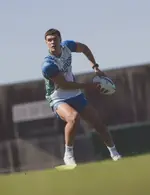
When teenage rugby prodigy Tom Perkins signed a four-year deal with the Newcastle Knights, he added his voice to a chorus growing too loud for New Zealand Rugby to ignore.
“[Rugby] league, in my opinion, is more entertaining to watch, and I think it fits my skill set a lot better,” says Perkins, just a week out from beginning preseason with the Knights NRL team.
Perkins is a 1.96m, 105kg loose forward who has played at the highest levels schoolboy rugby has to offer. Selected in the NZ Secondary Schools side soundly beaten twice by their Australian U18 opponents at the beginning of October, the 18-year-old was in the sights of four Super Rugby franchises and the national system.
The radar of teenage talent sweeps wider and beeps louder these days. To continue that analogy, one side appears to be hitting its targets more frequently. In October alone, rugby league swooped on three young men who looked to have NZ rugby firmly in their future.
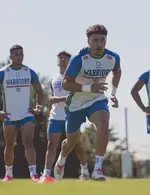
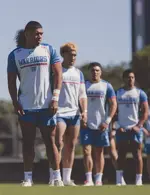
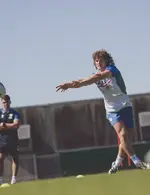
Harry Inch (NZ Warriors) and Saumaki Saumaki (South Sydney) will join Perkins in the 13-man code next year. Like Perkins, Inch and Saumaki are from the hugely successful Nelson College First XV programme (the trio played together in 2024) and both represented NZ Secondary Schools last year.
They’re singing from the same song sheet.
“The game of rugby league excites me and is a lot more entertaining as well,” says
Inch, who was linked to the Warriors earlier this month.
They have something else in common – they’re all managed by experienced dual-code player agent Bruce Sharrock.
“At times I’m seen as the antichrist that’s coming in and ripping these players out of rugby union,” says Sharrock, before reiterating he favours neither code.
“My involvement with rugby union has been 27 years and continues to be a dominant part of the business.”
Among his rugby union clients is All Black Rieko Ioane.
Sharrock was formerly a director and co-founder of sports management company Esportif International NZ Limited, which was acquired by large international company Wasserman.
They have league superstars Reece Walsh, Ezra Mam and Hamiso Tabuai-Fidow on their books. Locally, Sharrock represents the likes of Roger Tuivasa-Sheck and Leka Halasima.
“I’m the only one in the country that is accredited in both and understand both pathways at the elite level,” says Sharrock, who recently relocated to Christchurch.
Asked about the latest influx of top-tier rugby talent crossing codes, Sharrock is matter-of-fact.
“First and foremost, there’s nothing new. It’s not like there’s been this big development, and they’ve changed the landscape.”
He says there are, though, a number of contributing factors that have elevated rugby league, not least of all its growing profile and emphasis on entertainment.
“I always challenge them as to what code they ultimately want to play because if they’re passionate about it, they’ve got a greater chance of success.
“I say if there were two games on the television clashing, which one would you watch? More often than not, they’re saying they’ll watch the rugby league.
“That’s fact. That’s what they tell you,” says Sharrock.
Of course, there’s a follow-up question.
“Ultimately, what do you want to do? If you want to change code, do you understand what you’re walking into? They want to play. They love it,” says Sharrock.
These same conversations were had with Perkins. He gave the same answers.
“I just love how quick the game is. I think the problem with rugby union, there’s so much stop-start, but league is just super quick. A lot more running with the ball, a lot more aerial work, which I think fits my game a lot better as well,” says Perkins.
“To be fair, the deals are coming after that conversation, so it’s not ‘there’s a deal in front of me, so I want to grab it’.”
In the case of Inch and Saumaki, there were deals in front of them 12 months ago.
“Harry and Saumaki were targeted by rugby league straight out of school. So, the Warriors just missed out on getting both boys,” adds Sharrock.
Both stayed with rugby union. Both had a change of heart a year later.
The pathways
A common criticism in rugby circles is of its convoluted pathways. It’s a criticism shared by players and administrators. There is little clarity in how a school leaver continues his journey from First XV to the professional game.
“It’s somewhat cloudy even today as to what your pathway is,” says Sharrock.
“You have provincial unions who offer development contracts. These can be anywhere from $1 to probably about $2500. The very upper end is $5000. And they effectively have the provincial union providing some infrastructure and high performance for these young men.
“Tied into that is often the [Super Rugby] franchise is supporting the provincial unions and often leading it to give the young men further high-performance insight through the franchise team, exposure to training days or whatever. Beyond that, you kind of get lost.”
By contrast, NRL franchises have age group teams that start with under-17s – Harold Matthews Cup. Perkins will start in the SG Ball competition (under-19s) while Inch and Saumaki will get their first taste in Jersey Flegg (under-21s). The next step from there is the New South Wales Cup (reserve grade) before becoming fully-fledged first-grade players.
“These young guys are going through effectively travelling trans-Tasman, playing in a professional comp, even at the age of 17 through to 21. It’s so clear and well organised,” says Sharrock.
It’s not uncommon for top-grade NRL coaches to have some oversight on the development of those junior players, providing uniformed feedback.
“If you’re a young man at 16, who wants to give rugby league a shout, and you’ve got the physical profile that they look for, then they can easily put you into an environment where you could play a competition up until March or April, and still be part of your school’s First XV programme,” says Sharrock.
“And it’s high-performance elite style sport, and that’s something that rugby doesn’t have in the country for us.
“Yes, they have the First XV competition, but as we know, there’s a lot of schools that aren’t captured in that.
“Rugby league is offering them a really good, clear alternative and they’re saying, ‘This is great’. Add to that the financial side of it – it’s chalk and cheese.”
The money
One source who has seen contract negotiations play out between the codes says rugby is “bringing a knife to a gunfight”; such is the disparity between the offers.
Sharrock says he’s used the same expression.
If his young clients can go all the way to their club’s first-grade side, their salaries could be comparable with top tier All Blacks.
“Leka Halasima, look what happened to him. Showed he could play at the highest level at 19 - massive upgrades for four years,” says Sharrock.
At entry level, the NRL offers more than twice what Super Rugby players earn.
“The [NRL] top 30 minimum [salary] is now sitting at AU$140,000,” says Sharrock.
That equates to roughly $160,000 for the upcoming 2026 season.
And that money is likely to increase when the NRL renegotiates its broadcast rights. The next deal will come into effect in 2028 when the competition expands to 19 teams.
The current deal is reportedly worth $1.8b - but that could almost double according to some estimates. The flow-on effect would see franchises receive a greater share of those broadcast rights and have salary caps extended – meaning more money for players.
“That’s just going to raise the stakes yet again. I believe with the new deal, it could be closer to $200,000 minimum,” says Sharrock.
“The thing that people don’t really understand is the minimum salary for a Super Rugby player has hardly moved in 20 years.”
Super Rugby franchises must pay their contracted players a minimum of $75,000 per year but they can pay up to a maximum of $195,000 per year. NZR can step in to top up certain players’ salaries beyond that.
The opportunities in rugby league can also be multi-faceted. In Perkins’ case, he’ll live in brand-new custom-built accommodation with other like-minded young hopefuls and study at the University of Newcastle.
“That’s all taken care of, which is pretty awesome as well,” says Perkins, who will study commerce.
The players
Perkins’ story is something of a ‘sliding doors’ moment.
When the whistle blew to start the First XV pre-season clash with St Thomas of Canterbury College at Hanmer Springs in late April, he had no idea of the eyes he was about to catch.
Stood inconspicuously in the crowd that day was renowned talent scout, Peter O’Sullivan. His eyes have previously discovered Billy Slater, Greg Inglis and Israel Folau as schoolboys.
“I watched the game for about five minutes and thought, ‘Wow, who’s this big blonde number 8?’. I found someone in the crowd that knew him and knew his dad and introduced myself at halftime,” says O’Sullivan.
O’Sullivan, Newcastle’s head of recruitment, was in Christchurch for the Knights’ round 8 clash with the Warriors. The doors slid for Perkins when O’Sullivan decided to drive almost two hours to watch a game on a whim.
“I wasn’t going to watch anyone in particular. Sometimes they’re the best outcomes.Sometimes you just got to get lucky and be at the ground.”
The luck was shared by both parties. Perkins now finds himself heading to a club that is in a rebuild, having sacked their first-grade coach and lost a couple of international forwards. Among them Kai Pearce-Paul, an Englishman with a very similar build to Perkins.
“I think he’s more athletic than Kai Pearce-Paul, to be fair. He’s well put together. He moves well, beautiful balance.
“I definitely think he could play an edge given time in the NRL, but he’d certainly be able to play in the middle as well. He looks a special talent to me,” says O’Sullivan.
Harry Inch’s u-turn caught a few by surprise after a year that saw him get a taste of the Crusaders environment, including game time during their pre-season fixture against the Blues at Kirwee.
A year after spurning the Warriors’ advances, the curly mullet-wearing playmaker reconsidered. Farm-raised, Inch’s explanation is suitably agricultural.
“If a farmer waits for the perfect weather to sow his crop, he will never harvest anything. I felt like it was now or never, and these opportunities don’t come often,” says Inch.
Inch was a schoolboy star in the 10 jersey. If he is seen as a half by the Warriors, then his transition will be the toughest of the three. Not that Inch minds.
“I feel excited to give a new code a good crack and look forward to the new challenges that come with it,” says Inch.
Saumaki Saumaki is a powerhouse loose forward who is strong with ball-in-hand and devastating in defence. He’s an awkward shape in professional rugby – probably too short to continue his career at number 8 or blindside flanker, but he’s the perfect build for rugby league.
The Rabbitohs certainly think so, inking a two-year deal.
The future
As it stands, the professional rugby league options available to NZ’s best and brightest young players far outweigh the equivalent in rugby union. There are six Super Rugby franchises based in NZ. Playing anywhere else makes them ineligible for the All Blacks and the bumper payday that comes with the black jersey.
By comparison, there are 17 NRL clubs. For now.
In 2027, the Perth Bears will enter the NRL and they’re already actively trying to recruit.
The following year, the Papua New Guinea Chiefs will be the competition’s 19th team. They’ll be offering big money to import players – tax-free.
The battle for the signatures of young talent is only going to intensify. Sharrock believes there are lessons for NZR to learn from the NRL.
“It’s cut-throat. If they don’t like you after 12 months or two years, we’ll have a conversation about how we get you out of here. And dare I say to me that’s what rugby needs to start bringing in.
“You’ve got All Blacks on well-paid contracts who are really just taking money. Start trading, start doing what the world does. NBA, NFL, soccer, rugby league, they trade.
“At the end of the day, if you’re not worth what we’re now paying you, let’s have a conversation about an exit.
“There are competitions in France, Japan - if you’re allowed an early release, they would use the stock that we’ve got here. You would possibly get a transfer fee, make some money out of it, carry on.
“Having been involved in the rugby league world for as long, that’s the difference. It’s a commodity,” says Sharrock.
Despite leaving the sport for greener pastures, Perkins is nothing but appreciative of the opportunities rugby union has given him.
He’s given it all he had since he was a 5-year-old playing rippa.
But next season will be different – and that season starts soon.
“I’ve heard rugby league preseason is pretty tough, but I’m up for the challenge. I’m pretty excited,” says Perkins.
One top sports agent says rugby league offers clearer pathways and far better pay.

www.nzherald.co.nz


www.nzherald.co.nz